
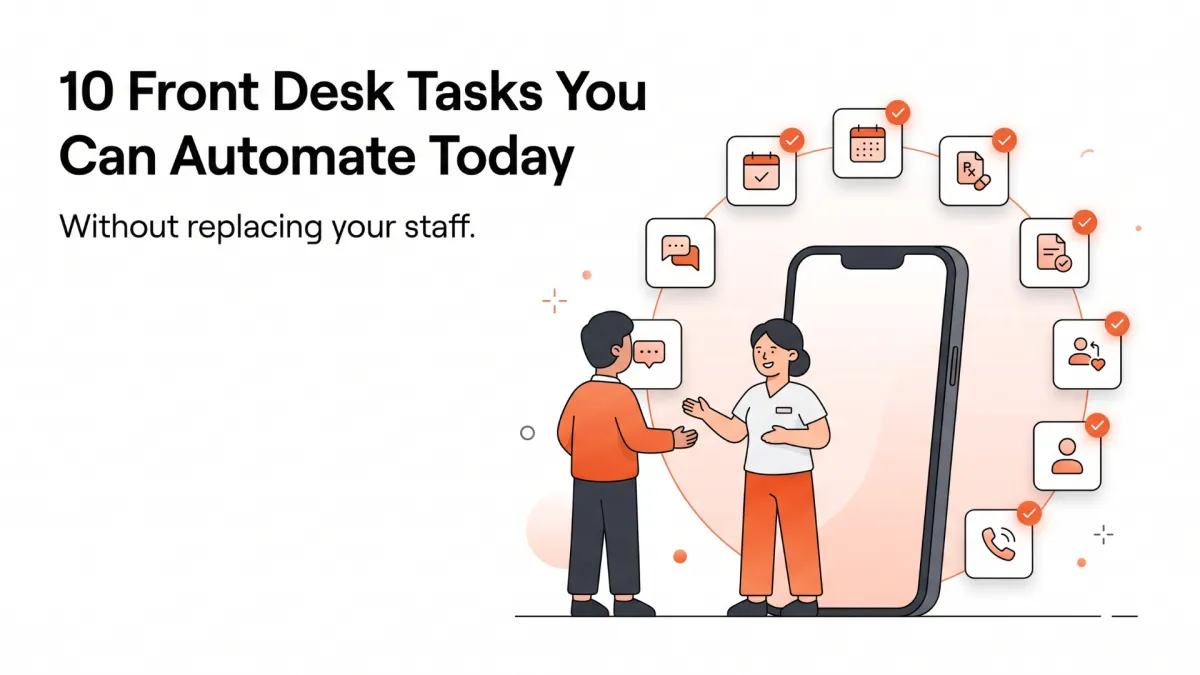
10 Medical Front Desk Tasks You Can Automate Without Replacing Staff
Your front desk doesn't have to handle every repetitive phone call and administrative task. Learn which daily responsibilities can be automated using AI, allowing your team to reduce interruptions, improve patient service, and increase efficiency without hiring more staff.
Every medical practice wants to improve efficiency.
Yet for many practices, the front desk remains overwhelmed.
Receptionists juggle ringing phones, patient check-ins, insurance verification, appointment scheduling, prescription refill requests, referrals, billing questions, and countless interruptions throughout the day.
The instinctive solution is often to hire another employee.
But hiring isn't always the answer.
In many cases, the biggest opportunity isn't adding staff. It's reducing repetitive work.
Modern AI and automation tools can handle many routine front desk responsibilities, allowing your existing team to focus on patient care instead of repetitive administrative tasks.
The goal isn't to replace your receptionists.
It's to give them more time to do what people do best.
Let's look at ten front desk tasks you can automate today.
1. Appointment Scheduling
Scheduling appointments is one of the most common reasons patients call.
Receptionists often spend hours every day asking the same questions:
Which provider would you like to see?
Are you a new patient?
What day works best?
Morning or afternoon?
An AI receptionist can handle these conversations automatically.
Patients receive immediate appointment options while your schedule stays synchronized with supported EMRs.
Benefits include:
Fewer scheduling calls
Immediate booking
Reduced hold times
Fewer callbacks
2. Appointment Rescheduling and Cancellations
Patients constantly need to change appointments.
Without automation, receptionists stop what they're doing every time the phone rings.
AI can:
Cancel appointments
Offer new appointment times
Update calendars instantly
Confirm changes with patients
Your staff stays focused while patients receive faster service.
3. Frequently Asked Questions
Every practice answers the same questions dozens of times each day.
Examples include:
What are your office hours?
Where are you located?
Do you accept my insurance?
Which providers are accepting new patients?
What should I bring to my visit?
Instead of repeatedly answering identical questions, AI provides instant, consistent responses.
4. Prescription Refill Requests
Medication refill requests consume significant administrative time.
Rather than leaving voicemail messages, patients can provide:
Medication name
Pharmacy
Date of birth
Callback number
The information is organized and sent to the appropriate clinical team.
This reduces interruptions while improving documentation.
5. Referral Requests
Patients frequently call asking whether referrals have been received.
Others need new referrals submitted.
AI can:
Collect referral details
Verify information
Route requests appropriately
Notify the correct staff member
Receptionists spend less time gathering repetitive information.
6. Insurance Questions
Insurance questions often involve basic information.
Examples include:
Do you accept my insurance?
Is my provider in network?
What information should I bring?
AI can answer many of these common questions instantly using your practice's approved information.
More complex cases can still be transferred to staff.
7. Patient Intake Information
Instead of collecting basic demographic information during busy office hours, AI can gather:
Name
Date of birth
Phone number
Email
Reason for visit
Preferred provider
Your staff begins the visit with much of the administrative work already completed.
8. Call Routing
Not every caller needs the receptionist.
Some need:
Billing
Medical records
Nurses
Referrals
Office manager
On-call provider
AI identifies the purpose of the call and routes patients appropriately.
This reduces unnecessary transfers and improves the patient experience.
9. After-Hours Calls
Your office may close at 5 PM.
Patients continue calling.
Instead of voicemail, AI can:
Schedule appointments
Answer routine questions
Collect refill requests
Document patient concerns
Route urgent situations
Patients receive immediate assistance while your team enjoys uninterrupted time away from work.
10. Call Documentation
Many receptionists spend valuable time documenting phone conversations after each call.
Modern AI automatically generates organized call summaries including:
Patient information
Reason for calling
Actions completed
Follow-up items
Instead of handwritten notes or lengthy voicemail messages, your team starts with structured information ready for review.
What Shouldn't Be Automated?
Automation isn't appropriate for every situation.
Human staff remain essential for:
Emotional conversations
Clinical decision making
Complex insurance issues
Financial counseling
Escalated patient complaints
In-person patient interactions
AI handles routine administrative work while people continue providing empathy, judgment, and personalized care.
Why Automation Doesn't Replace Receptionists
This is one of the biggest misconceptions surrounding AI.
Automation doesn't eliminate jobs.
It eliminates repetitive work.
Your receptionists still play a critical role in your practice.
By reducing interruptions, they can:
Spend more time helping patients in person
Resolve complex issues more effectively
Complete administrative work faster
Experience less workplace stress
Deliver a better patient experience
Practices often find that automation makes their existing employees happier rather than unnecessary.
How Much Time Can Automation Save?
Every practice is different.
However, consider how often your staff repeats the same conversations each day.
Scheduling.
Office hours.
Insurance.
Directions.
Prescription refills.
Appointment changes.
These routine interactions can consume several hours every day.
Even automating a portion of them gives your staff more time to focus on meaningful patient interactions.
How Zaya Automates Your Front Desk
Zaya was designed specifically for independent medical practices.
Rather than replacing your front desk, Zaya works alongside your existing team.
With Zaya, your practice can automate:
Appointment scheduling
Appointment changes
Frequently asked questions
Prescription refill requests
Referral requests
Insurance questions
Patient intake
Call routing
After-hours call handling
AI-powered call summaries
The result is a more efficient practice where patients receive immediate assistance and staff spend less time on repetitive administrative work.
Frequently Asked Questions
Will patients still be able to speak with someone?
Yes. Zaya transfers calls whenever human assistance is needed.
Does automation replace receptionists?
No. Automation reduces repetitive work so receptionists can focus on patients and more complex administrative responsibilities.
Can automation schedule appointments?
Yes. Zaya can schedule appointments directly into supported electronic medical record systems while following your scheduling rules.
What if a patient has an urgent concern?
Urgent situations follow your practice's predefined escalation workflow and can be transferred appropriately.
Is automation only useful for large practices?
Not at all. Independent practices often benefit the most because automation helps small teams accomplish more without hiring additional staff.
Work Smarter, Not Harder
Your front desk doesn't need to answer every repetitive phone call manually.
By automating routine administrative tasks, practices can improve patient access, reduce staff burnout, and create a more efficient operation without sacrificing the personal service patients expect.
The best medical practices don't replace people with technology.
They use technology to help people perform at their best.
That's exactly what Zaya was built to do.
Talk to Zaya
Experience the difference. Tap the microphone to start a natural conversation with our AI right now.
You'll need to allow microphone access to start the demo.