
How AI Answers Insurance Questions for Medical Practices
Insurance inquiries represent the largest volume of routine calls for independent medical practices, creating long hold times, front desk burnout, and interrupted patient check-ins. Traditional phone systems force receptionists to manually verify payer networks and explain benefits while handling in-person patient care. Implementing an AI phone receptionist automates these routine coverage questions completely. By providing immediate, accurate answers about accepted plans, referral requirements, and intake protocols 24/7, voice AI protects front desk bandwidth, reduces appointment drop-offs, and ensures a seamless experience for every caller.
For most independent medical practices, insurance questions are the single largest driver of inbound phone traffic. Every single day, receptionists answer dozens of variations of the exact same calls: "Do you take my insurance?", "Are you in-network with Blue Cross PPO?", "Do I need a referral from my primary care doctor?", and "How much will my co-pay be for a specialist visit?"
These inquiries are not inherently complicated, but their sheer volume creates a continuous operational bottleneck. Front desk staff are forced to repeatedly pause in-person patient check-ins, look up payer lists on sticky notes or internal spreadsheets, and attempt to explain complex benefit structures over a ringing phone line.
When a front desk team is trapped in a state of constant phone triage, administrative quality suffers. Hold times grow longer, patients in the waiting room feel neglected, and incoming calls from prospective patients go straight to voicemail.
Solving this challenge does not require hiring additional billing specialists or putting staff through endless phone training. It requires changing how routine insurance inquiries are captured and resolved before they ever interrupt your front office team.
The Heavy Administrative Load of Front Desk Insurance Calls
In a typical medical office, phone calls are not evenly distributed across the day. They arrive in concentrated surges—first thing in the morning, right after lunch, and during the final hour before closing. During these peak periods, receptionists are tasked with managing two competing priorities at once: caring for the patient standing at the counter and answering the phone line ringing in their ear.
Insurance questions make this balancing act nearly impossible. Unlike a simple request for clinic hours or directions, an insurance inquiry requires specific, accurate details. A receptionist must verify the exact payer name, determine whether the specific plan tier is in-network, check whether the provider accepts new patients under that payer, and clarify whether a referral is on file.
Because insurance networks change, contracts are updated, and plan names sound confusingly similar, these conversations often take three to five minutes per call. Multiply that duration by thirty or forty calls a day, and a front desk team spends several hours every shift acting as human directory lookup tools.
The administrative burden goes beyond phone time:
Receptionists are constantly interrupted while entering clinical notes or collecting co-pays.
In-office patients experience awkward delays while waiting for staff to finish phone conversations.
Front desk staff suffer from chronic fatigue caused by repetitive, high-friction dialogues.
Callers placed on hold frequently hang up before receiving an answer.
When administrative bandwidth is consumed by routine coverage checks, the practice loses the capacity to handle high-value tasks, such as managing complex scheduling, processing urgent care transfers, and delivering attentive, welcoming in-person care.
Why Answering Insurance Inquiries Manually Degrades the Patient Experience
A patient’s perception of clinical care begins long before they enter an exam room. It begins with their very first phone call. When a prospective patient calls to inquire about coverage and encounters operational friction, their confidence in the practice immediately drops.
Financial uncertainty is one of the leading causes of anxiety for healthcare consumers. Patients want clear, direct answers regarding whether their insurance will cover an upcoming visit and what their out-of-pocket obligation might look like. When staff sound rushed, uncertain, or put them on extended hold to double-check a payer list, that anxiety transforms into frustration.
The consequences of manual insurance handling are direct and measurable:
Extended Hold Times When a receptionist has to look up network participation while on the phone, the caller waits. Average hold times increase across the entire practice, driving up call abandonment rates.
Conflicting or Inaccurate Information When multiple staff members manage phone calls using informal lists or memory, inconsistency is inevitable. A patient may be told their plan is accepted on Monday, only to discover at check-in on Thursday that their specific sub-plan is out-of-network.
Missed Scheduling Opportunities A patient calling to ask if their insurance is accepted is usually a high-intent patient ready to book an appointment. If they reach voicemail or are left on hold while staff look up insurance details, they hang up and call the next practice on their search results page.
Surprise Billing Friction When coverage rules—such as necessary primary care referrals or pre-authorizations—are not communicated clearly during the initial phone call, patients arrive unprepared. This leads to awkward check-in conversations, delayed appointments, or unexpected out-of-pocket bills that ultimately result in negative online reviews.
Structural Challenges in Traditional Front Desk Workflows
To understand why practices struggle with insurance calls, it helps to examine the structural flaws inherent in traditional front office operations.
Dynamic Payer Networks Independent practices maintain contracts with dozens of commercial payers, Medicare, Medicaid, and regional Medicare Advantage plans. These contracts change annually. Keeping every front desk employee updated on every plan variation through manual spreadsheets or physical binders is structurally inefficient.
High Call Volume Velocity Inbound phone volume in healthcare is volatile. A single front desk receptionist cannot answer three incoming lines simultaneously while greeting a patient in the waiting room. When call volume spikes, callers are routed to voicemail or left ringing indefinitely.
Lack of Standardized Intake Scripts Different staff members explain insurance concepts in different ways. One receptionist might ask for the exact group number, while another simply asks for the primary payer name. This lack of standardization leads to incomplete record collection and downstream billing rejections.
After-Hours Communication Deficits Patients frequently research healthcare options and check their benefit details outside standard business hours. When a patient calls at 7:00 PM to confirm whether a clinic takes their insurance, a traditional answering machine provides zero utility, forcing the patient to look elsewhere.
Practical Strategies for Managing Inbound Coverage Questions
Addressing the front desk phone crisis requires a structured operational strategy. Medical practice leaders can implement several practical measures to reduce the volume of routine insurance calls hitting their staff.
Standardize Payer Documentation Centralize all in-network and out-of-network plan lists into a single digital document that is updated systematically by the billing department. Eliminate loose notes, paper cheat-sheets, and unverified memory lookups.
Establish Clear Pre-Screening Protocols Create a standardized script for front office staff to collect primary insurance details, subscriber IDs, and referral statuses during the initial phone intake. Standardizing this data collection prevents back-and-forth callbacks later.
Publish Comprehensive Insurance Directories Online Ensure the practice website maintains an up-to-date, searchable list of accepted insurance plans, along with clear guidelines on whether primary care referrals are required for specialist visits.
Offload Routine Phone Inquiries Before They Reach Staff The most effective way to protect front desk bandwidth is to intercept routine coverage inquiries before they ring through to the reception desk. By using automated voice intelligence, practices can answer insurance questions instantly and gather necessary card details without human intervention.
The Tangible Benefits of Offloading Insurance Inquiries
When an independent medical practice removes routine insurance lookups from the front desk's daily task list, the positive impact is felt immediately across clinical, operational, and financial metrics.
100% Call Answer Rate Automating routine phone interactions ensures every caller receives immediate service. Call abandonment drops to zero, and prospective patients are never left waiting on hold or sent to voicemail.
Faster In-Office Patient Processing When receptionists are not tied to ringing phones, they can focus entirely on arriving patients. Check-in lines move faster, copays are collected without rushing, and waiting room satisfaction increases.
Higher Appointment Capture Rates Patients inquiring about insurance are guided seamlessly from coverage verification to appointment scheduling within the same interaction. Removing phone friction prevents lost patient acquisition.
Reduced Staff Burnout and Turnover Eliminating repetitive, stressful phone interruptions creates a calm, organized work environment. Front office personnel can concentrate on high-value patient management rather than frantic multitasking.
Fewer Claim Denials and Intake Errors Automated intake systems collect standardized subscriber details, group numbers, and payer names with high precision, significantly reducing billing errors caused by illegible handwriting or rushed phone entries.
How Intelligent Voice AI Handles Complex Insurance Inquiries
Modern artificial intelligence has transformed healthcare phone operations. Voice AI platforms go far beyond traditional press-button phone trees or basic auto-attendants. Today’s conversational AI engages callers in natural, human-like dialogue, understanding context, nuance, and intent.
When an AI phone receptionist manages inbound insurance calls, it executes a precise, practice-defined workflow.
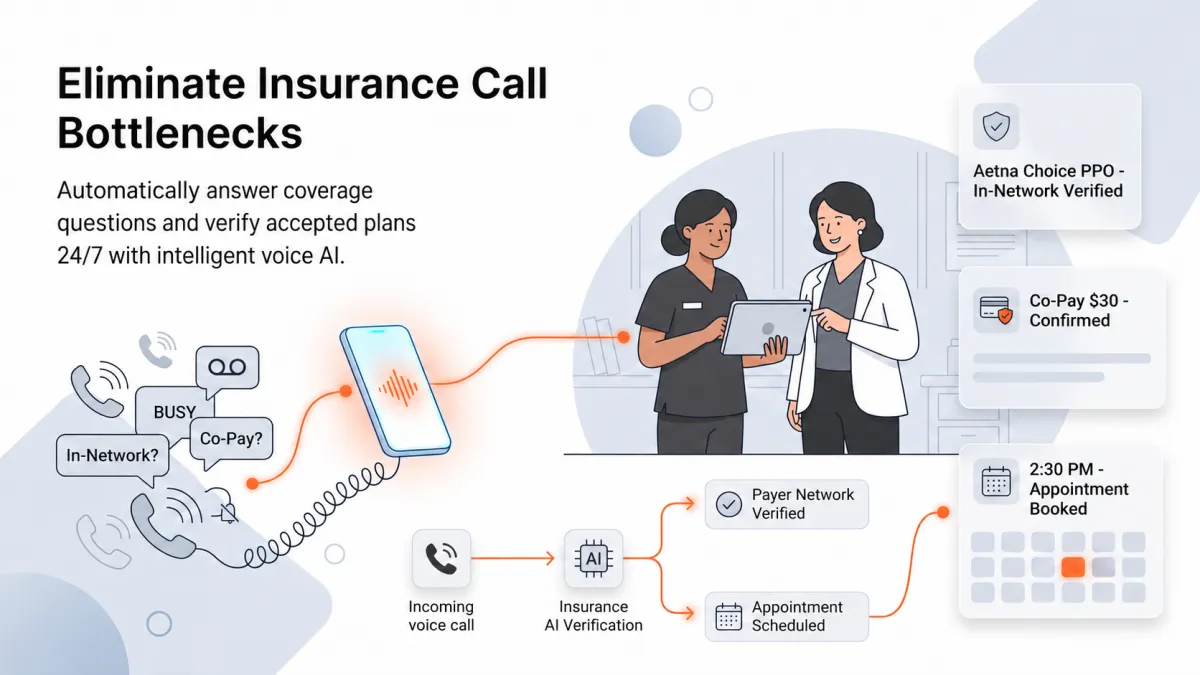
Natural Conversational Dialogue The AI greets the caller and listens naturally. The patient does not need to navigate rigid menus; they simply state their question, such as, "Hi, I want to know if Dr. Smith is in-network with Aetna Choice POS II."
Instant Network Participation Verification The AI cross-references the caller's specific insurance provider and plan type against the practice’s live database. It provides an immediate, accurate confirmation of whether the practice is in-network, out-of-network, or requires specific plan tiers.
Referral Requirement Clarification If the caller’s plan requires a referral from a primary care provider—such as an HMO plan—the AI clearly explains the requirement before booking, guiding the patient on how to have their primary doctor submit the necessary paperwork.
Standardized Information Collection If the caller wishes to book an appointment, the AI collects subscriber names, member IDs, group numbers, and date of birth in a structured format, preparing the file for automated eligibility verification.
Smart Escalation to Billing or Clinical Staff If a patient calls with a highly complex billing dispute, a claims inquiry, or a nuanced clinical question, the AI intelligently routes the call or creates a structured summary for the billing team, ensuring human intervention occurs only when truly necessary.
How Zaya Helps Independent Medical Practices
Zaya provides an AI-powered phone receptionist built specifically for the operational demands of independent medical practices. Designed to integrate directly into existing practice workflows, Zaya eliminates phone bottlenecks, protects front desk bandwidth, and ensures every patient receives immediate, accurate service.
Zaya acts as an intelligent, secure extension of your administrative team, supporting your practice across several core operational capabilities:
Answers every call: Answers 100% of inbound calls instantly on the first ring, completely eliminating hold times, busy signals, and dropped calls 24 hours a day, 7 days a week.
Schedules appointments: Manages scheduling workflows for new and existing patients according to provider-specific rules, visit types, and calendar availability.
EMR integration: Connects securely with leading electronic medical record and practice management systems to read real-time availability and record patient details automatically.
Appointment changes: Processes cancellations, reschedules, and visit confirmations automatically, keeping provider calendars full without manual staff intervention.
Prescription refill requests: Gathers structured medication and pharmacy details from callers, organizing the information into clean requests for clinical team review.
Referral handling: Captures incoming referral information from callers or medical offices, collecting demographic details and routing documentation to the correct department.
Multilingual conversations: Communicates naturally in multiple languages, ensuring diverse patient populations can easily check coverage and schedule care.
AI-generated summaries: Generates concise written call transcripts and structured summaries, giving your staff instant context for every interaction.
After-hours support: Delivers full booking and coverage information services outside normal clinic hours, capturing evening and weekend call traffic that would otherwise be lost.
By handling high-volume call management automatically, Zaya allows your front desk staff to deliver exceptional in-person care while ensuring your practice operates at peak efficiency.
Frequently Asked Questions
Why do insurance-related calls consume so much front desk time?
Insurance questions often require staff to verify payer networks, confirm plan eligibility, check referral requirements, and explain coverage details. Since these calls typically take several minutes each and occur repeatedly throughout the day, they create significant administrative strain and interrupt patient-facing responsibilities.
What are the biggest risks of handling insurance inquiries manually?
Manual insurance verification can lead to longer hold times, inconsistent information, missed appointment opportunities, frustrated patients, and increased staff burnout. It also raises the likelihood of intake errors that may contribute to claim denials or billing issues.
How can medical practices reduce routine insurance phone calls?
Practices can reduce call volume by maintaining an up-to-date online insurance directory, standardizing intake procedures, centralizing payer information, and using AI-powered phone receptionists to answer common coverage questions before they reach front desk staff.
Can AI accurately answer insurance coverage questions?
Yes. AI phone receptionists can be configured with your practice's current payer list, accepted plan types, referral requirements, and other practice-specific policies. This allows callers to receive consistent, accurate information based on the latest available data.
Does AI replace front desk staff?
No. AI is designed to handle repetitive, high-volume administrative calls, allowing receptionists to focus on higher-value responsibilities such as assisting patients in person, coordinating care, and managing more complex administrative tasks.
Can AI help patients outside normal business hours?
Absolutely. AI phone receptionists are available 24/7 to answer insurance questions, provide practice information, schedule appointments, process cancellations, and collect patient information, ensuring patients receive assistance even when the office is closed.
How does AI improve the patient experience?
By eliminating long hold times and providing immediate answers to insurance and scheduling questions, AI reduces patient frustration, builds confidence in the practice, and makes it easier for prospective patients to book appointments without delays.
What benefits can independent medical practices expect from automating insurance inquiries?
Automating routine insurance calls helps practices improve front desk efficiency, increase appointment conversion rates, reduce staff stress, minimize intake errors, and deliver a faster, more consistent patient experience while allowing staff to focus on meaningful patient interactions.
Support Your Front Desk by Automating Insurance Inquiries
Insurance-related phone calls may seem routine, but their cumulative impact on independent medical practices is significant. Constant interruptions, extended hold times, and repetitive coverage questions reduce front desk efficiency, increase staff fatigue, and create unnecessary friction for patients seeking care.
By combining standardized insurance workflows with intelligent voice AI, practices can dramatically reduce administrative burdens while ensuring patients receive fast, accurate answers whenever they call. Instead of spending valuable staff time on repetitive coverage checks, front office teams can focus on delivering exceptional in-person service and supporting higher-value clinical operations.
For practices looking to improve patient access, protect staff productivity, and streamline daily operations, automating routine insurance inquiries is a practical step toward a more efficient and patient-centered healthcare experience.
Talk to Zaya
Experience the difference. Tap the microphone to start a natural conversation with our AI right now.
You'll need to allow microphone access to start the demo.