
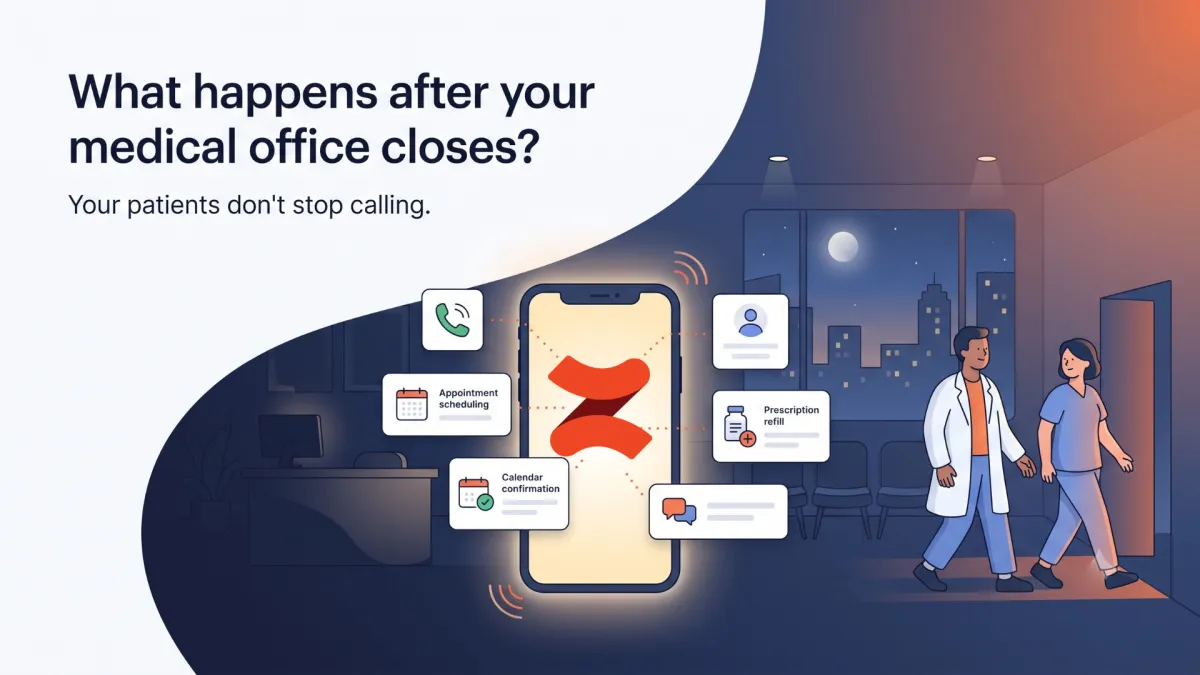
What Happens After Medical Office Hours? How AI Keeps Practices Open 24/7
Patients don't stop calling when your office closes. An AI receptionist keeps your medical practice available 24/7 by answering calls, booking appointments, handling routine questions, and ensuring every patient receives immediate assistance without adding work for your staff.
Most medical practices close their doors between 5:00 and 6:00 PM.
Patients don't.
People remember to schedule appointments after dinner. Parents call once their children are asleep. Professionals finally have time to deal with healthcare after leaving work. Others wake up with symptoms at 2:00 AM and want to know what to do next.
Unfortunately, when they call your office, they're often greeted by voicemail.
That one missed interaction can cost your practice a new patient, delay care, or create unnecessary work for your front desk the next morning.
Today's patients expect convenience. They expect businesses to be available when they need them. Healthcare is no different.
This is where an AI receptionist changes the equation.
Instead of sending callers to voicemail, an AI receptionist answers every call, every hour of the day, schedules appointments directly into your EMR, answers common questions, and ensures no patient feels ignored.
Why After-Hours Calls Matter More Than You Think
Many practices assume that most important calls happen during business hours.
In reality, some of the highest-value patient interactions occur after the office closes.
These include:
• New patients searching for a physician
• Parents trying to schedule pediatric appointments
• Patients needing to reschedule appointments
• Prescription refill requests
• Insurance questions
• Referral inquiries
• Patients checking office hours or locations
• Patients deciding whether their concern is urgent
Without someone answering the phone, many callers simply move on to another practice.
Patients have options.
If they cannot reach your office quickly, they'll often call the next physician listed on Google.
The Problem With Traditional Voicemail
Voicemail has remained largely unchanged for decades.
It asks patients to:
"Leave a message and we'll return your call."
From the practice's perspective, that sounds reasonable.
From the patient's perspective, it introduces uncertainty.
They don't know:
• When someone will call back
• Whether their message was received
• Whether they should call again
• Whether another practice could help sooner
By the next morning, your front desk may have dozens of voicemail messages waiting.
Staff members now have to:
• Listen to every message
• Prioritize callbacks
• Return missed calls
• Reach patients who may no longer answer
• Handle incoming calls while working through yesterday's backlog
Instead of starting the day organized, your staff starts behind.
Healthcare Doesn't Operate on Business Hours
Healthcare needs don't follow a schedule.
Patients call whenever healthcare becomes important to them.
That might be:
7:30 PM after finishing work.
9:00 PM when a child develops a fever.
6:00 AM before leaving for the office.
Sunday afternoon while reviewing referrals.
Holiday weekends.
If your office is unavailable during those moments, patients may never call back.
What Happens When an AI Receptionist Answers Instead?
An AI receptionist transforms the entire after-hours experience.
Instead of voicemail, patients immediately hear a friendly voice ready to help.
The conversation feels natural.
The AI can understand what the patient needs and guide them appropriately.
Depending on your practice, it can:
• Schedule appointments
• Reschedule visits
• Cancel appointments
• Answer frequently asked questions
• Provide office hours
• Explain directions
• Collect new patient information
• Handle referral requests
• Process prescription refill requests
• Route urgent concerns appropriately
The patient receives immediate assistance.
Your staff arrives the next morning with fewer callbacks and a cleaner schedule.
Direct EMR Appointment Scheduling
One of the biggest advantages of modern AI receptionists is direct integration with your electronic medical record.
Instead of writing down appointment requests for staff to process later, the AI can book directly into your schedule.
This means:
• Real-time appointment availability
• No double booking
• No manual scheduling
• Immediate patient confirmation
• Updated physician calendars
For the patient, the experience feels no different than speaking with an experienced receptionist.
For the practice, it's one less task for the front desk.
Patients Expect Immediate Service
Think about the last time you contacted a business.
Whether it was a restaurant, hotel, airline, or bank, you probably expected someone to answer immediately.
Healthcare patients have developed similar expectations.
While they understand physicians are busy, they don't expect to wait until the next business day simply to schedule an appointment.
Practices that provide faster responses consistently create stronger first impressions.
Supporting Your Staff Instead of Replacing Them
A common misconception is that AI receptionists replace front desk employees.
In reality, they make receptionists more effective.
Your staff still manages:
• Complex patient concerns
• Insurance issues requiring human judgment
• Clinical coordination
• In-person patient interactions
• Physician requests
The AI handles repetitive conversations that consume valuable time.
This allows your team to focus on work that truly requires people.
Better Experiences for New Patients
Imagine two practices.
Practice A:
Patient calls at 7:30 PM.
Voicemail answers.
Patient hangs up.
Practice B:
Patient calls at 7:30 PM.
An AI receptionist answers immediately.
The AI gathers information.
Checks physician availability.
Schedules an appointment.
Confirms the visit.
Which practice earns the new patient?
The answer is obvious.
Multilingual Support Around the Clock
Many communities include patients who feel more comfortable speaking languages other than English.
An AI receptionist can communicate naturally in multiple languages, including Spanish and many others, without requiring separate staffing.
Patients receive the same level of service regardless of when they call.
That improves access while helping practices serve their communities more effectively.
Handling High Call Volumes After Hours
Monday mornings are notoriously busy because calls accumulate over the weekend.
An AI receptionist dramatically reduces this surge.
Instead of waking up to dozens of voicemail messages, your staff arrives knowing many patients have already:
• Scheduled appointments
• Received answers
• Submitted refill requests
• Started referral workflows
• Had their questions addressed
The phone lines remain manageable, and the team can begin the day focused on patient care instead of catching up.
Consistent Service Every Time
Human receptionists naturally have varying energy levels throughout the day.
They may be helping another patient, handling paperwork, or assisting physicians.
An AI receptionist provides the same professional experience on every call.
Every patient receives:
• Immediate attention
• Accurate information
• Consistent communication
• Reliable appointment scheduling
Consistency builds trust with patients and strengthens your practice's reputation.
Is an AI Receptionist Right for Every Practice?
Practices benefit the most when they experience:
• High call volumes
• Frequent missed calls
• Staffing shortages
• Rapid growth
• Busy specialists
• Multiple providers
• After-hours patient demand
Whether you're a family medicine clinic, specialty practice, urgent care, or private physician office, being available around the clock can significantly improve both patient satisfaction and operational efficiency.
Keep Your Practice Open Even When the Office Is Closed
Your office hours shouldn't determine when patients can access your practice.
Every unanswered call represents a patient seeking care.
Some want information.
Some need reassurance.
Many simply want to schedule an appointment.
An AI receptionist ensures those opportunities aren't lost.
By answering calls 24/7, scheduling appointments directly into your EMR, supporting your staff, and delivering a better patient experience, your practice remains available even after the lights go out.
That's not simply better technology.
It's better access to care.
Talk to Zaya
Experience the difference. Tap the microphone to start a natural conversation with our AI right now.
You'll need to allow microphone access to start the demo.