
Medical Answering Service vs AI Receptionist: Which Is Better?
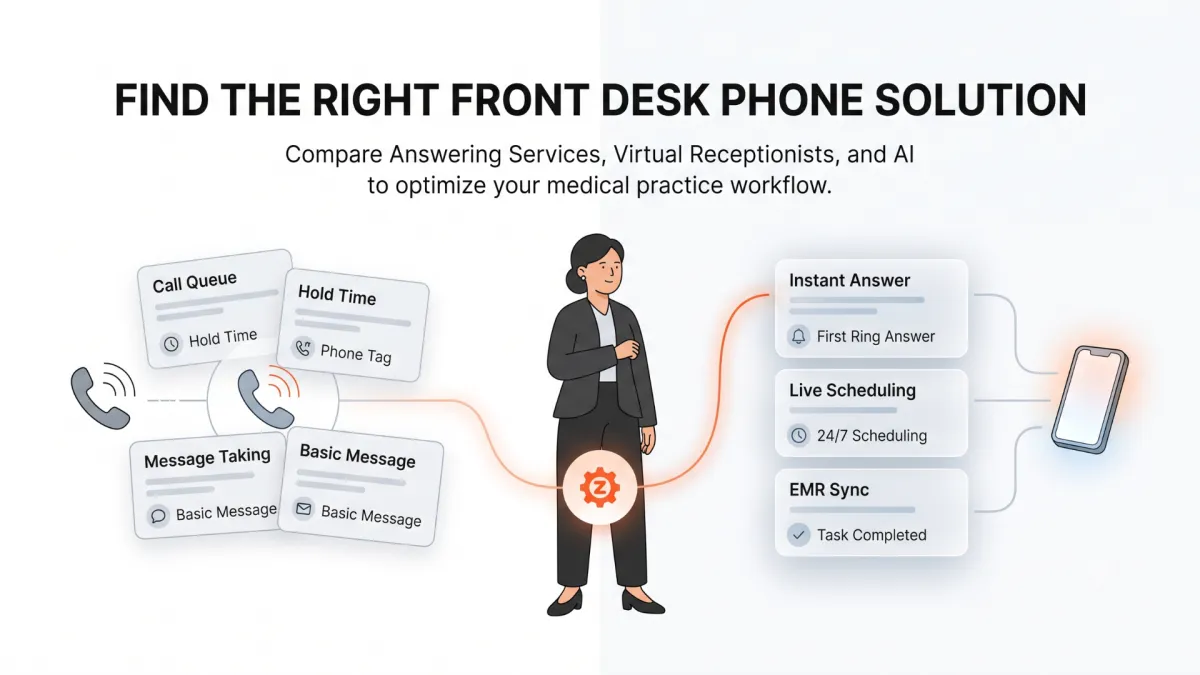
Independent medical practices evaluating front desk support often compare medical answering services, virtual receptionists, and AI receptionists. Traditional answering services rely on third-party operators who take basic messages after hours, but they cannot schedule appointments or integrate with your EMR. Virtual receptionists provide a more human touch during business hours, but they are expensive, struggle with high call spikes, and face high turnover. AI receptionists offer a modern solution by answering 100% of calls instantly 24/7, integrating directly with your EMR, booking appointments, handling routine intake, and eliminating hold times at a fraction of the cost.
Managing inbound phone calls is one of the most persistent operational challenges for independent medical practices. Every day, front desk teams handle an overwhelming stream of calls, including new patient inquiries, routine scheduling, prescription refill requests, referral transfers, and urgent clinical questions.
When phone volume exceeds your front office capacity, patient access suffers. Calls are placed on long holds, routed to voicemail boxes, or dropped entirely. For a busy practice, unanswered calls lead directly to lost revenue, frustrated patients, higher staff burnout, and negative online reviews.
To handle call overflow and after-hours communication, practice leaders typically evaluate three distinct solutions: traditional medical answering services, remote virtual receptionists, and modern AI receptionists. While all three aim to solve phone bottlenecks, their underlying operations, capabilities, costs, and impacts on patient experience vary significantly.
Choosing the right communication model requires understanding how each option functions within your daily practice workflows, EMR infrastructure, and overall growth strategy.
Why Front Desk Phone Operations Fail
In a typical independent practice, phone traffic is volatile and unpredictable. Call volume spikes during specific intervals, particularly first thing in the morning, immediately after lunch, and right before the clinic closes for the day.
During these peak hours, front office staff are forced to manage two competing communication channels at the exact same time. They must check in arriving patients at the front counter while simultaneously trying to answer ringing phone lines.
Human etiquette dictates that the patient standing at the counter receives immediate attention. As a result, incoming phone calls are routinely placed on hold or sent to voicemail.
Patients wait on hold for ten minutes just to ask a basic office question.
Staff members feel continuously rushed, leading to tense patient interactions.
Prospective patients hanging up during peak hours call competing practices instead.
Voicemails accumulate throughout the day, creating an overwhelming callback backlog for clinical staff.
Relying solely on in-person front desk personnel to handle heavy inbound call volume creates a permanent operational bottleneck that limits practice growth and degrades the patient experience.
Understanding the Three Front Office Phone Models
To resolve call bottlenecks, practice owners usually turn to external coverage solutions. Understanding the structural differences between traditional answering services, virtual receptionists, and AI receptionists is essential for making an informed operational decision.
1. Medical Answering Services
Traditional medical answering services have been the standard coverage option for decades, operating primarily after hours and on weekends. They employ live operators in remote call centers who follow basic call scripts. When a patient calls, the operator records a brief message and forwards it to the office via email, fax, or secure portal. If the caller reports a medical emergency, the operator attempts to patch the call through to the on-call physician based on a physical roster.
2. Virtual Receptionists
Virtual receptionist services provide remote, off-site human staff who handle calls during normal business hours or designated overflow periods. These operators function as an off-site extension of your front office. They answer calls using your practice name, answer general questions, transfer calls to internal staff, and sometimes log into your software via remote desktop setups to book appointments manually.
3. AI Receptionists
An AI receptionist is an automated voice platform designed specifically for healthcare phone operations. Utilizing advanced conversational voice technology, natural language processing, and direct API integrations with Electronic Medical Record (EMR) systems, the AI engages callers in natural, human-like dialogue. It answers calls instantly on the first ring, handles complex scheduling logic, processes prescription refills, answers practice questions, and syncs data to your EMR in real time without human intervention.
Comparing Key Features Across Phone Solutions
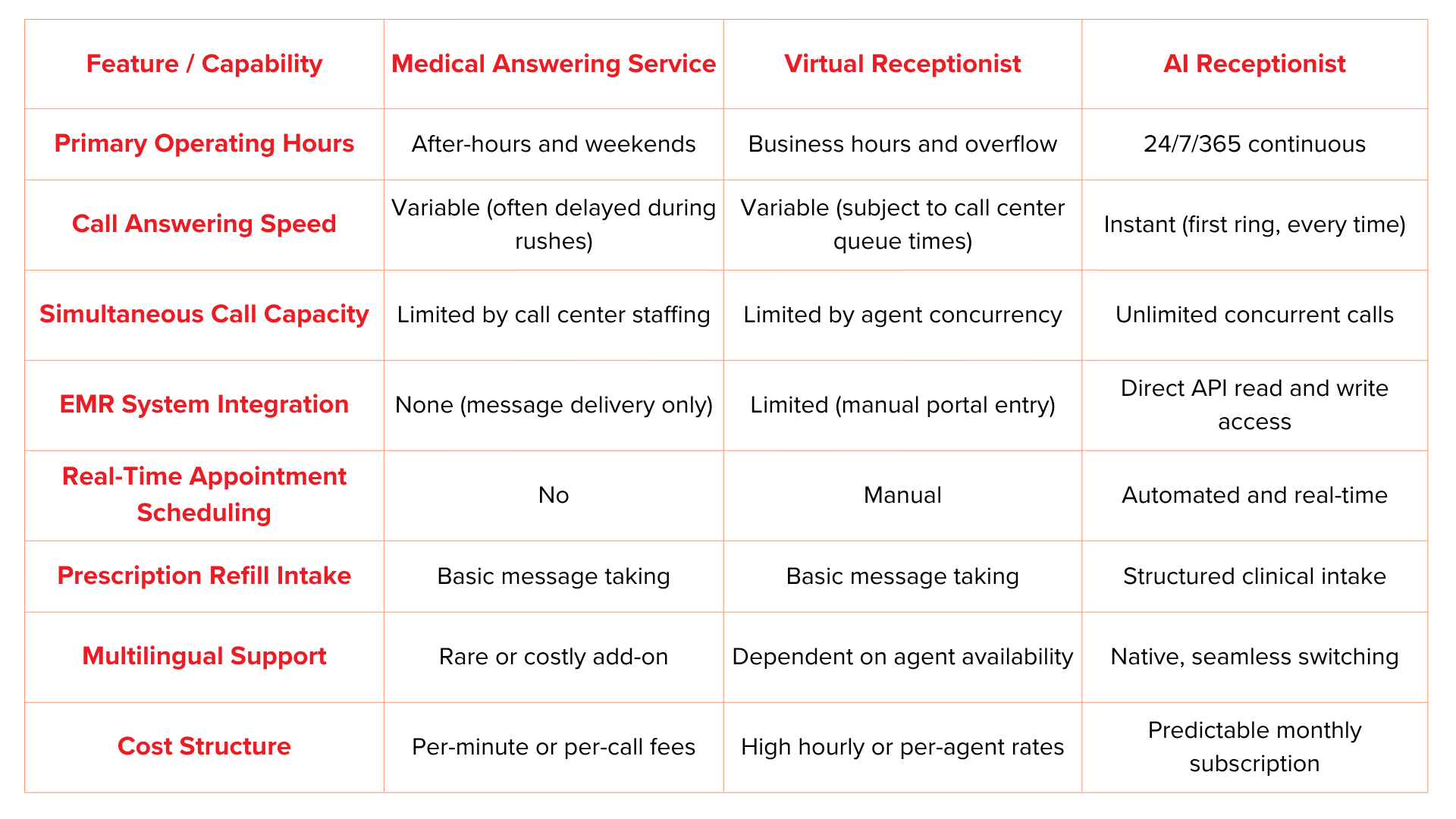
In-Depth Breakdown: Medical Answering Services
Medical answering services provide a basic safety net for after-hours communications, but their operational limitations make them unsuitable for modern practice management.
The Advantages
Established Industry Presence: Most practices are familiar with setting up basic call forwarding to an answering service for after-hours emergency coverage.
Human Operator Presence: Calls are answered by a live human operator, which some traditional practices prefer for emergency triaging.
Emergency Escalation: Operators can follow basic escalation protocols to contact on-call physicians for urgent medical situations after hours.
The Limitations
No Systems Integration: Traditional answering services operate entirely outside your EMR and practice management software. Operators cannot view your schedule, verify appointments, or check patient records.
High Phone Tag Friction: Because operators can only take messages, every non-emergency call creates a task for your internal staff the following morning, initiating an inefficient cycle of phone tag.
Variable Quality and Accuracy: Call center operators manage lines for dozens of different businesses simultaneously. Misspelled patient names, incorrect contact numbers, and misheard medical details are common.
Unpredictable Costs: Most answering services charge based on total call minutes or individual call counts, leading to unexpected invoice spikes during high-volume months.
In-Depth Breakdown: Virtual Receptionists
Virtual receptionists attempt to offer a complete front desk experience from a remote location, providing dedicated human interaction during business hours.
The Advantages
Professional Brand Presentation: Remote operators greet callers using your practice name and can follow customized greeting scripts to match your office tone.
Complex Human Reasoning: Remote human agents can navigate complex, non-standard customer service scenarios that require personal judgment.
Inbound Call Filtering: Virtual receptionists screen incoming calls, handling simple inquiries and transferring high-value or urgent calls to your in-office staff.
The Limitations
High Operational Costs: Virtual receptionist services represent a significant ongoing expense. Rates are typically structured around dedicated monthly operator hours or high per-minute charges.
Staff Turnover and Lack of Training: Off-site call centers experience high employee turnover. Remote operators often lack familiarity with your specific providers, sub-specialty rules, or clinic policies.
Concurrency and Queue Bottlenecks: Like your internal team, virtual receptionist services rely on human capacity. When call volume spikes across their client base, your callers face long wait times in remote queues.
Security and EMR Access Risks: Granting remote, third-party operators login access to your EMR system introduces security management oversight and potential HIPAA compliance vulnerabilities.
In-Depth Breakdown: AI Receptionists
AI receptionists represent a modern approach to healthcare communication, combining instant availability, conversational speech capabilities, and deep software integration.
The Advantages
Zero Wait Times and Infinite Scale: An AI receptionist answers every inbound call instantly on the first ring. It can manage hundreds of calls simultaneously, eliminating hold times during morning call spikes.
Direct EMR Integration: The AI interfaces directly with practice management software to read live provider calendars, apply scheduling rules, book visits, and update patient demographics in real time.
24/7 Operational Capabilities: Patients receive full service at any time of day or night, enabling after-hours scheduling, cancellation processing, and prescription refill intake.
Consistent Quality and Compliance: The system executes practice protocols with 100% consistency on every call, maintaining strict HIPAA security standards and clear communication.
Predictable Financial ROI: Fixed monthly subscription pricing allows practices to scale call capacity without increasing administrative overhead or paying per-minute penalties.
The Limitations
Requires Initial Protocol Setup: The practice must clearly define its scheduling rules, provider preferences, and triage guidelines during initial configuration.
Technical Integration Dependencies: Full scheduling functionality requires an EMR system that supports secure API connectivity or integration access.
How to Evaluate Which Model Fits Your Practice
Selecting the right phone infrastructure depends on your practice size, call volume, budget, and operational goals.
Choose a Medical Answering Service if: You only require basic after-hours message taking for urgent clinical emergencies, do not need after-hours scheduling, and operate with low call volume.
Choose a Virtual Receptionist if: You have a flexible budget, require human oversight for complex non-standard calls, and do not mind manual message processing by your internal team.
Choose an AI Receptionist if: You want to eliminate hold times, capture lost scheduling revenue 24/7, integrate directly with your EMR, reduce front desk staff burnout, and scale operations cost-effectively.
For the vast majority of growing independent practices, transitioning from manual message-taking to automated, EMR-integrated voice workflows yields immediate operational efficiency and higher patient retention.
How Zaya Helps Practices Move Beyond Traditional Phone Coverage
Choosing between a medical answering service, a virtual receptionist, and an AI receptionist ultimately comes down to how much of your phone workflow you want to automate.
Traditional medical answering services are designed primarily to take messages, while virtual receptionists rely on human staff to answer calls and manually complete administrative tasks. Both can help reduce missed calls, but they often create additional work for your front office through callbacks, manual scheduling, and message processing.
Zaya is built to eliminate those operational bottlenecks. Instead of simply answering calls, it resolves routine patient requests during the conversation by booking appointments, handling cancellations, collecting prescription refill requests, answering common office questions, and documenting interactions in real time through EMR integration.
Because Zaya answers every call instantly and can manage multiple conversations simultaneously, practices don't have to worry about peak-hour call queues, after-hours voicemail backlogs, or missed appointment opportunities. Front desk staff spend less time returning phone messages and more time assisting patients who are physically in the office.
For independent medical practices looking to improve patient access while reducing administrative workload, Zaya combines the always-available coverage of an answering service with the workflow automation and real-time capabilities of an AI receptionist—helping practices deliver a faster, more efficient patient experience without expanding administrative headcount.
Frequently Asked Questions
What is the difference between a medical answering service and an AI receptionist?
A medical answering service primarily takes messages and forwards them to your staff, often after business hours. An AI receptionist actively manages patient interactions by answering questions, scheduling appointments, processing cancellations, collecting prescription refill requests, and integrating directly with your EMR or practice management system.
Is an AI receptionist better than a virtual receptionist?
It depends on your practice's needs. Virtual receptionists provide live human support but are limited by staffing capacity and business hours. AI receptionists can answer unlimited simultaneous calls 24/7, automate routine administrative tasks, and provide consistent service while allowing your staff to focus on patients in the office.
Can an AI receptionist integrate with my EMR?
Yes. Many healthcare AI receptionists integrate with electronic medical record (EMR) or practice management systems to access provider schedules, book appointments, update patient information, and document call activity in real time. Integration capabilities depend on your existing software.
Can AI receptionists reduce missed calls?
Yes. Because AI receptionists answer every call immediately and can manage multiple conversations simultaneously, they help eliminate missed calls, long hold times, and voicemail backlogs that often lead to lost appointment opportunities.
Are AI receptionists suitable for small private practices?
Absolutely. Independent practices often have limited front desk resources and experience unpredictable call volume throughout the day. AI receptionists help smaller practices improve patient access, reduce staff burnout, and maintain consistent phone coverage without hiring additional administrative staff.
Can AI receptionists answer calls after hours?
Yes. AI receptionists provide 24/7 coverage, allowing patients to schedule appointments, request prescription refills, ask common office questions, or leave structured information outside of normal business hours while following your practice's after-hours protocols.
Medical Answering Service vs. Virtual Receptionist vs. AI Receptionist: Which Solution Is Best for Your Practice?
Choosing the right phone solution can have a direct impact on patient satisfaction, staff productivity, and practice revenue. While traditional medical answering services and virtual receptionists continue to serve important roles, they often rely on manual processes that create delays, increase administrative workload, and limit scalability.
AI receptionists offer a more modern approach by combining instant call answering, automated scheduling, real-time EMR integration, and 24/7 availability into a single solution. Rather than simply taking messages, they help practices resolve patient requests during the first interaction, reducing callbacks and improving access to care.
For independent medical practices looking to reduce front desk pressure, capture more appointment opportunities, and deliver a faster, more consistent patient experience, an AI receptionist provides a scalable solution that supports both operational efficiency and long-term growth. By understanding the strengths and limitations of each option, you can choose the communication model that best fits your practice's needs today while preparing for future growth.
Talk to Zaya
Experience the difference. Tap the microphone to start a natural conversation with our AI right now.
You'll need to allow microphone access to start the demo.