
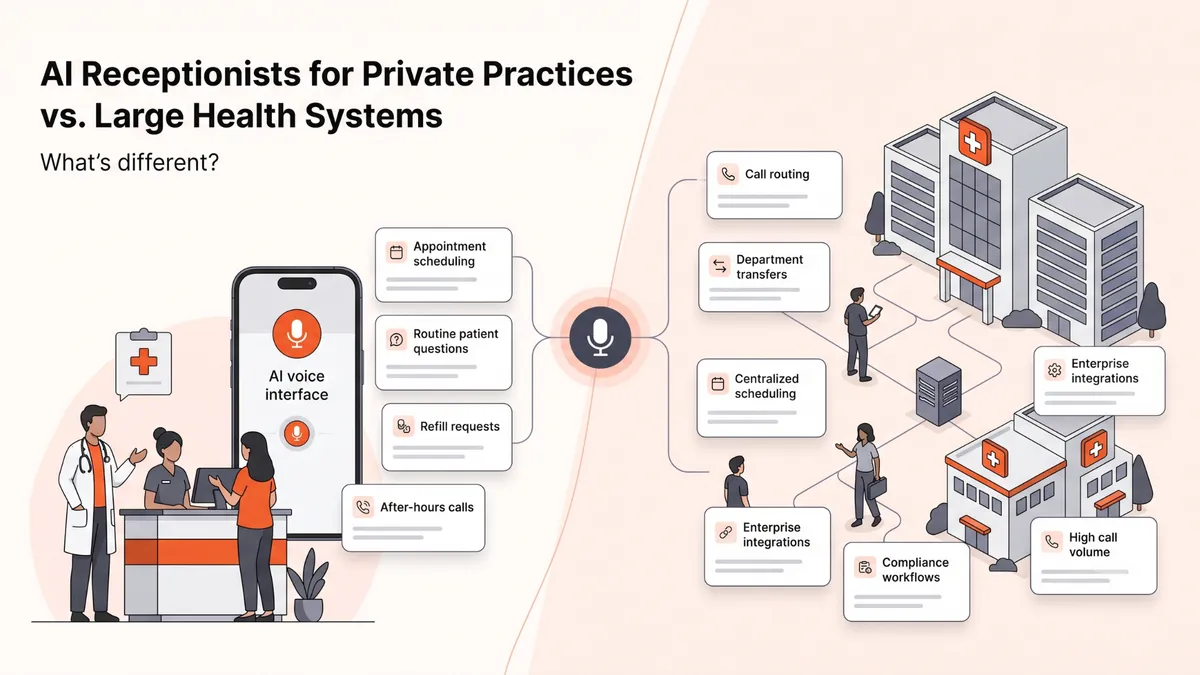
AI Receptionists for Private Practices vs. Large Health Systems: What's Different?
AI receptionists are becoming increasingly common across healthcare.
Both independent medical practices and large health systems are looking for ways to answer more calls, reduce hold times, improve scheduling, and ease the burden on front desk staff.
At first glance, the technology appears to do the same job regardless of the organization.
A patient calls.
The AI answers.
The patient's request is understood, and the appropriate action is taken.
But behind the scenes, the requirements are very different.
A private practice needs a solution that is easy to implement, highly personalized, and affordable.
A large health system needs a solution that can operate across hundreds of providers, multiple departments, complex scheduling rules, and enterprise-level technology systems.
Understanding these differences helps practices choose an AI receptionist designed for their environment instead of adopting a solution built for someone else's.
What Does an AI Receptionist Do?
An AI receptionist answers incoming patient calls using conversational voice technology.
Instead of navigating long phone menus, patients simply explain why they are calling.
Depending on your practice's workflow, the AI can:
Schedule appointments
Reschedule or cancel appointments
Answer common patient questions
Collect prescription refill requests
Process referral inquiries
Route calls to the appropriate department
Gather patient information
Generate call summaries
Escalate urgent situations based on your protocols
These capabilities benefit both small practices and large health systems.
The difference lies in how those workflows are configured.
Private Practices Have Simpler Operations
Most private practices have relatively straightforward workflows.
A typical practice may include:
One to ten providers
One or two office locations
A single EMR
A small front desk team
Limited appointment types
One phone number
Because the organization is smaller, decisions happen quickly.
Scheduling rules are easier to define.
Staff members often perform multiple roles and communicate directly with one another.
This allows an AI receptionist to be customized around the way the practice already operates.
Large Health Systems Are Much More Complex
Health systems often consist of:
Multiple hospitals
Dozens or hundreds of clinics
Thousands of providers
Numerous specialties
Centralized scheduling centers
Multiple phone numbers
Multiple technology platforms
A patient calling the health system may not even know which department they need.
The AI must determine:
Which facility the patient wants
Which specialty is appropriate
Whether the patient is new or established
Which scheduling team owns the appointment
Whether referrals are required
Which insurance rules apply
What seems like a simple phone call can involve numerous routing decisions.
Implementation Looks Very Different
Private practices can often deploy an AI receptionist in weeks.
Implementation usually involves:
Learning practice workflows
Configuring appointment rules
Connecting the phone system
Integrating with the EMR
Testing common patient scenarios
Training staff
Since there are relatively few decision-makers, adjustments happen quickly.
Large health systems require a much longer process.
Implementation may involve:
IT
Information Security
Compliance
Legal
Operations
Scheduling leadership
Clinical leadership
Patient access teams
Executive approval
Each department may have its own requirements before the system goes live.
Scheduling Complexity
Scheduling appointments is one of the biggest differences between the two environments.
In a private practice, the AI may only need to know:
Which provider the patient wants
Whether they are a new patient
The reason for the visit
Preferred appointment dates
The AI can often book the appointment immediately.
Large health systems have significantly more variables.
Scheduling may depend on:
Multiple provider calendars
Department-specific rules
Referral requirements
Insurance restrictions
Procedure availability
Equipment scheduling
Centralized scheduling teams
Multiple clinic locations
Some appointments can be booked automatically.
Others require transfer to specialized scheduling staff.
Customization vs. Standardization
Private practices usually value flexibility.
Each physician may have different scheduling preferences.
Examples include:
Same-day appointments
Annual wellness visits
Procedure consultations
Telemedicine visits
Follow-up appointments
The AI must adapt to those individual workflows.
Large health systems typically prioritize standardization.
Leadership wants patients to receive a consistent experience regardless of which location they contact.
This requires standardized:
Greetings
Patient verification
Escalation protocols
Documentation
Quality monitoring
Reporting
Balancing consistency with specialty-specific workflows becomes one of the biggest challenges.
Technology Integrations
Private practices generally have fewer systems.
An AI receptionist may integrate with:
The EMR
The phone system
Appointment scheduling
SMS reminders
Practice messaging
Health systems often require connections with:
Enterprise EMRs
Contact center software
Identity management platforms
Referral management
Revenue cycle systems
Analytics platforms
Data warehouses
Patient portals
Integration becomes significantly more complex.
Call Routing
Routing calls inside a private practice is usually straightforward.
Calls may go to:
Reception
Nurses
Billing
Referrals
Medical records
Large organizations may have hundreds of possible destinations.
Calls may need to be routed based on:
Specialty
Provider
Clinic
Insurance
Patient age
Time of day
Clinical urgency
The routing logic becomes one of the largest components of the implementation.
Cost Considerations
Private practices typically have smaller budgets.
They need solutions that provide immediate operational value.
Their goals often include:
Reducing missed calls
Booking more appointments
Avoiding additional hiring
Supporting after-hours callers
Improving front desk efficiency
Large health systems often invest more heavily in enterprise technology.
However, implementation also involves:
Project management
Security reviews
Compliance
Change management
Training
Ongoing governance
The investment is larger because the scale is much greater.
Measuring Success
Private practices often measure success using practical metrics such as:
Calls answered
Appointments booked
Missed calls reduced
After-hours calls handled
Staff time saved
Patient satisfaction
Health systems frequently track additional enterprise metrics, including:
Call containment
Transfer accuracy
First-call resolution
Contact center workload
Department performance
Enterprise reporting
Cost savings across the organization
Staff Adoption
Smaller practices generally adapt more quickly.
The front desk team can immediately see how AI reduces repetitive work.
Feedback can be incorporated within days.
Large organizations require formal change management.
Different departments need different training.
Staff must understand:
What AI can do
When calls transfer to humans
How quality is monitored
How workflows are updated
Successful adoption depends as much on communication as technology.
Both Still Need Human Staff
AI receptionists are not intended to replace people.
There are many situations where human judgment remains essential.
These include:
Emotional conversations
Clinical decision-making
Complex insurance issues
Financial counseling
Escalated complaints
Sensitive medical discussions
The AI should recognize these situations and transfer patients appropriately.
The goal is not full automation.
The goal is handling routine conversations while allowing staff to focus on higher-value interactions.
Which Organization Benefits More?
Both benefit, but in different ways.
Private practices often see faster operational improvements because implementation is simpler.
Benefits include:
Fewer missed calls
More appointments booked
Less front desk stress
Better after-hours coverage
Reduced administrative burden
Large health systems benefit through scale.
Benefits include:
Consistent patient experiences
Improved access
Reduced call center workload
Better reporting
Enterprise-wide operational efficiency
Neither approach is better.
They simply solve different operational challenges.
How Zaya Supports Independent Medical Practices
Zaya was built specifically for independent medical practices.
Rather than creating a complicated enterprise contact center, Zaya focuses on helping smaller practices answer every patient call while reducing front desk workload.
With Zaya, practices can:
Answer calls 24/7
Schedule appointments directly into supported EMRs
Handle appointment changes
Answer frequently asked questions
Process prescription refill requests
Route urgent calls appropriately
Support multilingual conversations
Generate AI-powered call summaries
The result is a smoother patient experience without adding complexity to daily operations.
Frequently Asked Questions
Can a private practice benefit from an AI receptionist?
Yes. Independent practices often see significant improvements in call answering, appointment scheduling, after-hours coverage, and front desk efficiency because they typically have simpler workflows and faster implementation timelines.
Are AI receptionists different for hospitals?
The underlying technology is similar, but hospitals and large health systems require more complex routing, enterprise integrations, governance, and standardization across many departments and locations.
Is implementation faster for private practices?
In most cases, yes. Private practices usually have fewer decision-makers, fewer technology systems, and simpler scheduling rules, allowing implementation to move much more quickly.
Will AI replace receptionists?
No. AI handles repetitive administrative conversations while receptionists focus on patient care, complex requests, and situations that require empathy and human judgment.
Can AI integrate with an EMR?
Yes. Many AI receptionists, including Zaya, can integrate with supported electronic medical record systems to schedule appointments, follow practice-specific rules, and document patient interactions.
Choosing the Right AI Receptionist
There is no one-size-fits-all AI receptionist.
Private practices need flexibility, simplicity, and rapid implementation.
Large health systems need enterprise-scale architecture, governance, and advanced integrations.
Understanding these differences helps healthcare organizations invest in technology that aligns with their operational needs.
For independent practices, the biggest opportunity isn't building enterprise complexity.
It's answering every call, reducing front desk workload, improving patient access, and delivering a better patient experience.
That's exactly what Zaya was designed to do.
Talk to Zaya
Experience the difference. Tap the microphone to start a natural conversation with our AI right now.
You'll need to allow microphone access to start the demo.