
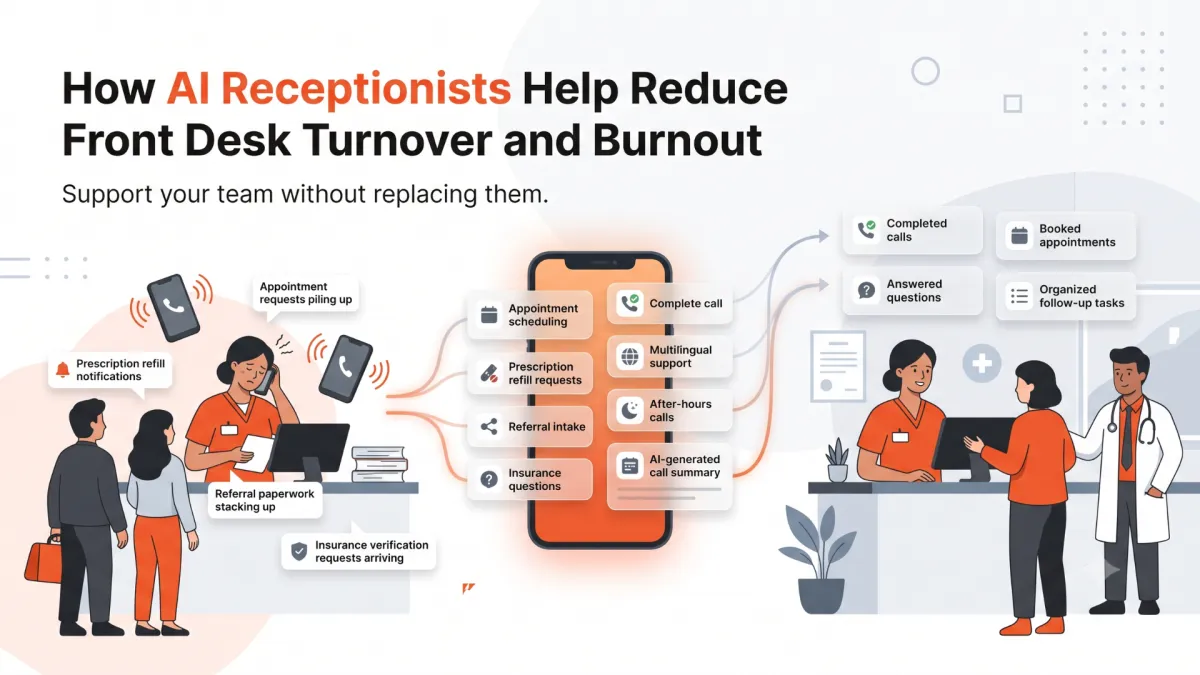
How AI Receptionists Help Reduce Front Desk Turnover and Burnout
Front desk burnout is one of the leading causes of staff turnover in medical practices. AI receptionists reduce repetitive phone calls, minimize interruptions, answer routine patient questions, and provide after-hours support, allowing receptionists to focus on higher-value work while improving both employee satisfaction and patient experience.
The front desk is the heartbeat of every medical practice.
Receptionists answer calls, greet patients, schedule appointments, verify insurance, process referrals, collect payments, coordinate with providers, and solve countless problems throughout the day.
They're often the first person patients interact with and the last person they see before leaving the office.
Yet despite their importance, front desk staff experience some of the highest levels of stress and turnover in healthcare.
Constant interruptions, rising patient expectations, staffing shortages, and increasing administrative responsibilities have made the role more demanding than ever.
Hiring new employees helps, but it doesn't address the underlying problem.
Many practices are discovering that reducing repetitive work is just as important as increasing headcount.
This is where AI receptionists are making a meaningful difference.
Rather than replacing receptionists, AI helps them spend less time on repetitive phone calls and more time on work that truly requires human interaction.
Why Front Desk Burnout Is Increasing
Medical receptionists have always managed multiple responsibilities.
Today, those responsibilities continue to grow.
A typical day may include:
Answering dozens of phone calls
Scheduling appointments
Checking patients in
Collecting copays
Verifying insurance
Managing referrals
Processing prescription refill requests
Responding to portal messages
Coordinating with providers
Handling patient complaints
Every few minutes, a ringing phone interrupts another task.
Over time, constant multitasking becomes mentally exhausting.
The Cost of Constant Interruptions
Research has shown that frequent interruptions reduce productivity and increase mental fatigue.
For receptionists, interruptions happen continuously.
While checking in a patient, the phone rings.
While verifying insurance, another call arrives.
While helping a physician, someone asks about appointment availability.
Staff rarely have the opportunity to complete one task before another demands attention.
This constant switching contributes significantly to workplace stress.
Patients Feel the Pressure Too
Burnout affects more than employees.
Patients notice it as well.
An overwhelmed receptionist may have:
Less time for meaningful conversations
Longer hold times
Delayed callbacks
Increased scheduling errors
Less patience during difficult interactions
Most receptionists genuinely want to provide excellent service.
The challenge is having enough capacity to do so consistently.
Turnover Creates a Cycle
When experienced receptionists leave, practices lose valuable knowledge.
New employees must learn:
EMR workflows
Scheduling rules
Provider preferences
Insurance processes
Referral requirements
Office policies
Training requires experienced staff to step away from their own work.
As remaining employees absorb additional responsibilities, their own stress increases.
The cycle repeats.
Hiring Alone Doesn't Solve Burnout
Adding another receptionist certainly increases capacity.
However, if every employee continues spending most of the day answering repetitive phone calls, burnout can still occur.
The underlying workload hasn't changed.
It has simply been divided among more people.
Practices need to reduce unnecessary work as well as distribute it.
Which Tasks Create the Most Repetition?
Many incoming calls involve the same questions every day.
Examples include:
Scheduling appointments
Rescheduling visits
Office hours
Directions
Accepted insurance plans
Prescription refill requests
Referral questions
Appointment confirmations
These conversations are important.
They are also highly repetitive.
AI Handles Repetitive Conversations
An AI receptionist can answer these routine calls immediately.
Patients receive assistance without waiting on hold.
Depending on your workflow, AI can:
Schedule appointments
Reschedule or cancel visits
Answer common questions
Collect prescription refill requests
Gather referral information
Route calls appropriately
Support patients after hours
Meanwhile, receptionists remain focused on patients who need personal attention.
Fewer Interruptions Mean Better Focus
When routine phone calls are handled automatically, receptionists gain longer periods of uninterrupted work.
This allows them to:
Complete insurance verification
Assist patients at the front desk
Resolve complex scheduling issues
Coordinate with providers
Finish administrative tasks more efficiently
The workday becomes more manageable.
AI Doesn't Replace Empathy
One of the biggest misconceptions about AI is that it replaces people.
In reality, healthcare still depends on human relationships.
Patients experiencing emotional situations, complex insurance issues, or sensitive concerns often need to speak with a person.
AI should recognize these situations and transfer the call appropriately.
By removing repetitive administrative conversations, receptionists have more time and emotional energy for interactions that truly benefit from empathy and human judgment.
Better Workdays Improve Retention
Employees are more likely to stay in roles where they feel supported.
Reducing repetitive work can improve:
Job satisfaction
Workplace morale
Focus
Productivity
Confidence
Patient interactions
Receptionists spend more of their day helping patients instead of rushing from one interruption to the next.
Burnout Affects the Entire Practice
High turnover impacts every department.
Providers may experience scheduling delays.
Managers spend time recruiting instead of improving operations.
Experienced staff devote hours to training new employees.
Patients receive less consistent service.
Reducing burnout benefits the entire organization, not just the front desk.
After-Hours Support Reduces Morning Backlogs
Many practices receive dozens of calls after closing.
Without AI, those calls become voicemail messages waiting for staff the next morning.
Receptionists begin the day returning calls before handling new ones.
An AI receptionist can answer after-hours calls by:
Scheduling appointments
Answering routine questions
Collecting refill requests
Gathering referral information
Escalating urgent situations when appropriate
Morning workloads become more manageable.
Happier Employees Create Better Patient Experiences
Patients often judge a practice by their interactions with the front desk.
When receptionists have more time to focus, they can:
Welcome patients warmly
Answer questions thoroughly
Resolve problems more effectively
Reduce mistakes
Spend more time helping each individual
Supporting staff ultimately improves patient satisfaction.
AI Supports Growth Without Overloading Staff
As practices grow, call volume usually grows as well.
Without additional support, existing employees absorb the extra workload.
Eventually, burnout increases.
AI allows practices to manage increasing patient demand without proportionally increasing repetitive administrative work.
Staff can continue delivering high-quality service even as the practice expands.
Signs Your Front Desk May Be Experiencing Burnout
Burnout often develops gradually.
Warning signs include:
Increased absenteeism
Higher staff turnover
Frequent overtime
Missed calls
Longer hold times
Delayed callbacks
Increased scheduling errors
Lower employee morale
Patient complaints about phone access
Recognizing these signs early allows practices to address operational issues before employees decide to leave.
Burnout Prevention Is Better Than Constant Hiring
Recruiting and training new receptionists is expensive.
Preventing burnout is often more cost-effective than replacing employees repeatedly.
Reducing repetitive administrative work helps preserve the knowledge and experience already within your practice.
How Zaya Helps Reduce Front Desk Burnout
Zaya was designed specifically for independent medical practices.
Rather than replacing your receptionists, Zaya works alongside them by handling repetitive patient conversations and ensuring every caller receives prompt assistance.
With Zaya, practices can:
Answer calls 24/7
Handle multiple calls simultaneously
Schedule appointments directly into supported EMRs
Process appointment changes
Answer common patient questions
Collect prescription refill requests
Support multilingual conversations
Generate AI-powered call summaries
Route urgent situations according to your workflow
The result is a calmer front desk, happier employees, and a better patient experience.
Frequently Asked Questions
Does AI replace medical receptionists?
No. AI is designed to automate repetitive administrative conversations while allowing receptionists to focus on patient interactions, complex requests, and responsibilities that require human judgment.
How does AI reduce burnout?
By reducing repetitive phone calls, minimizing interruptions, supporting after-hours callers, and handling routine questions, AI helps staff work more efficiently with less daily stress.
Can AI answer multiple calls at once?
Yes. AI can manage multiple patient conversations simultaneously, reducing hold times and preventing missed calls during busy periods.
Will patients still be able to speak with someone?
Absolutely. AI should transfer patients to staff whenever human assistance, empathy, or clinical judgment is needed.
Can AI improve employee retention?
While no technology eliminates turnover completely, reducing repetitive work and improving daily workflows can increase job satisfaction and reduce one of the major contributors to burnout.
Support Your Team Before Replacing Your Team
Medical receptionists play an essential role in every patient experience.
As workloads continue to increase, simply asking staff to work harder is not a sustainable strategy.
Reducing repetitive work allows receptionists to focus on what they do best: helping patients, solving problems, and creating a welcoming experience.
By answering routine calls, reducing interruptions, and extending patient access beyond office hours, AI receptionists help practices create a healthier work environment while improving operational efficiency.
For many independent medical practices, supporting the team you already have is one of the smartest investments you can make—and that's exactly what Zaya was built to do.
Talk to Zaya
Experience the difference. Tap the microphone to start a natural conversation with our AI right now.
You'll need to allow microphone access to start the demo.