
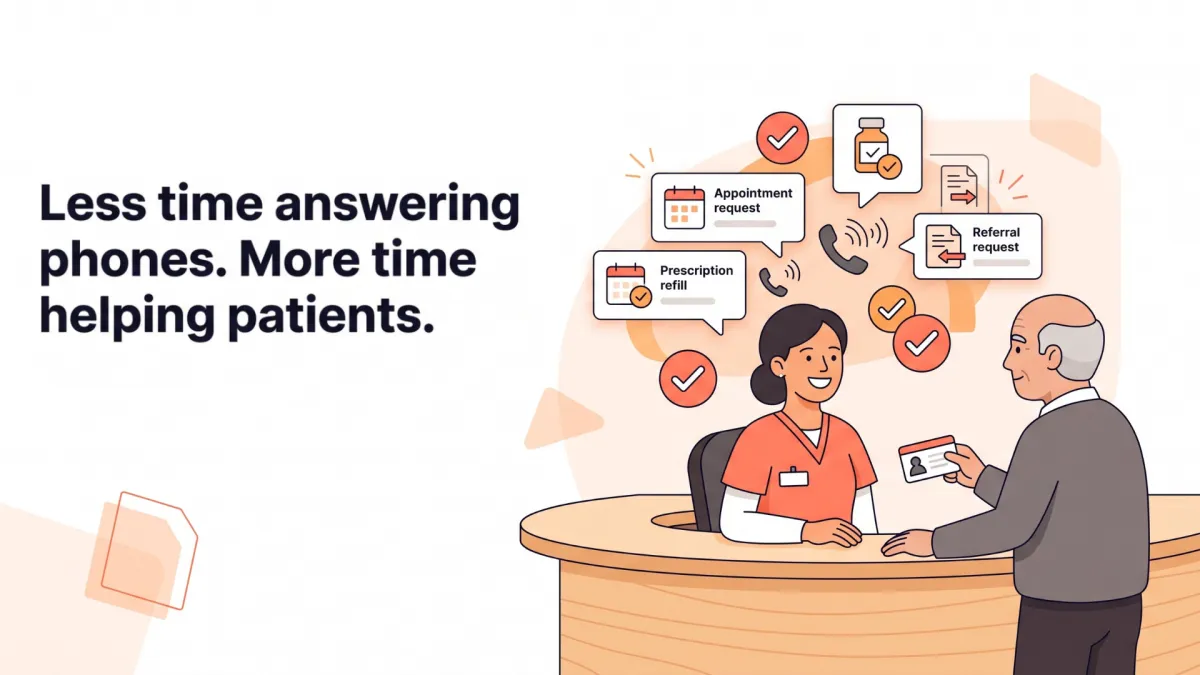
How to Reduce Medical Practice Call Volume Without Hiring Staff
High call volume doesn't always mean you need more employees. Discover practical strategies to reduce repetitive phone calls, improve patient communication, and free up your front desk using online scheduling, automation, and AI-powered call handling.
Every phone call to your practice represents a patient who needs help.
Some are trying to schedule appointments. Others need prescription refills, referral updates, insurance information, or answers to routine questions.
While every call is important, not every call requires a member of your front desk staff.
As practices continue to face staffing shortages and rising patient expectations, reducing unnecessary call volume has become one of the most effective ways to improve efficiency without compromising patient care.
The goal isn't to answer fewer calls.
The goal is to eliminate unnecessary calls while ensuring every patient still receives timely, high-quality service.
Here's how successful medical practices are doing exactly that.
Why Medical Practices Receive So Many Phone Calls
Most physicians underestimate how much time their front desk spends on the phone.
Depending on the size of the practice, receptionists may answer dozens or even hundreds of calls every day.
The majority of these conversations fall into a handful of categories.
Patients commonly call to:
Schedule appointments
Reschedule or cancel visits
Request prescription refills
Ask about insurance coverage
Confirm office hours
Check referral status
Request medical records
Speak with a nurse
Ask billing questions
Find directions to the office
Many of these conversations follow the same predictable workflow.
That makes them excellent candidates for automation.
The Hidden Cost of High Call Volume
Every incoming phone call interrupts another task.
Imagine a receptionist checking in a patient while simultaneously answering the phone.
A provider asks for assistance.
A pharmacy calls regarding a refill.
Another patient arrives at the front desk.
Meanwhile, two additional calls are waiting.
Even experienced staff eventually become overwhelmed.
High call volume often leads to:
Longer hold times
Missed calls
Increased voicemail
Delayed callbacks
Staff burnout
Lower patient satisfaction
Lost appointment opportunities
Reducing unnecessary calls doesn't just improve efficiency.
It improves the experience for both patients and employees.
Which Calls Should Be Reduced?
Not every phone call should disappear.
Patients should always have easy access to your practice.
Instead, focus on reducing routine conversations that don't require human judgment.
Examples include:
Appointment scheduling
Appointment reminders
Office hours
Insurance participation
Directions
Frequently asked questions
Prescription refill requests
Referral status updates
Automating these interactions allows your staff to spend more time on conversations that truly require personal attention.
Strategy 1: Offer Online Appointment Scheduling
One of the easiest ways to reduce incoming calls is by allowing patients to schedule appointments online.
Patients increasingly expect self-service options.
Giving them the ability to book appointments anytime reduces the need to call during office hours.
Benefits include:
Fewer scheduling calls
Greater patient convenience
Reduced administrative work
Higher patient satisfaction
Not every patient will use online scheduling, but many will appreciate the option.
Strategy 2: Improve Your Website
Many incoming calls happen because patients can't quickly find basic information.
Review your website and make sure it clearly includes:
Office hours
Accepted insurance plans
Provider biographies
Appointment request forms
New patient information
Directions
Parking information
Frequently asked questions
Contact information
A well-designed website answers questions before patients ever pick up the phone.
Strategy 3: Encourage Patient Portal Usage
If your practice offers a patient portal, encourage patients to use it.
Portals allow patients to:
View appointments
Request prescription refills
Access medical records
Send secure messages
Review visit summaries
Many routine requests can be handled without a phone call.
Educating patients about these features reduces unnecessary call volume over time.
Strategy 4: Automate Routine Conversations
Not every phone call requires a receptionist.
Many follow nearly identical scripts every day.
Examples include:
"What time do you open?"
"Do you accept Blue Cross?"
"I'd like to schedule an appointment."
"I need to refill my medication."
These conversations can often be handled automatically while maintaining a professional patient experience.
Automation reduces interruptions without sacrificing service.
Strategy 5: Use an AI Receptionist
This is where many practices see the biggest improvement.
Instead of sending callers to voicemail, an AI receptionist answers immediately.
Patients can:
Schedule appointments
Ask common questions
Request prescription refills
Receive office information
Leave detailed messages
Be transferred when appropriate
Rather than waiting for callbacks, patients receive immediate assistance.
Meanwhile, your front desk remains focused on patients already in the office.
What About After-Hours Calls?
Many patients don't have time to call during normal business hours.
They call:
Before work
During lunch
After work
On weekends
During holidays
Without after-hours coverage, these calls often become voicemail messages.
Unfortunately, many patients won't wait for a callback.
An AI receptionist ensures your practice remains available even when the office is closed.
Patients receive assistance immediately while your team enjoys uninterrupted time away from work.
Reducing Call Volume Doesn't Mean Reducing Patient Access
Some practices worry that automation creates barriers for patients.
The opposite is usually true.
Patients don't necessarily want to speak with a receptionist.
They want their question answered.
If they can schedule an appointment in less than two minutes without waiting on hold, that's often a better experience than navigating multiple transfers.
The goal is to make communication easier, not more complicated.
How Zaya Helps Medical Practices Reduce Call Volume
Zaya was designed specifically for healthcare.
Instead of replacing your front desk, it supports your team by handling routine conversations automatically.
With Zaya, your practice can:
Answer every incoming call
Schedule appointments directly into supported EMRs
Collect prescription refill requests
Answer frequently asked questions
Route urgent calls appropriately
Generate AI call summaries
Support multiple languages
Remain available 24 hours a day
The result is fewer interruptions, happier patients, and a more productive staff.
Signs Your Practice Is Ready for Automation
You may benefit from reducing call volume if:
Receptionists spend most of the day on the phone.
Patients frequently reach voicemail.
Hold times continue increasing.
Staff report feeling overwhelmed.
Appointment scheduling consumes hours every day.
Patients regularly ask the same questions.
Your office receives significant after-hours call volume.
If several of these sound familiar, automation may provide immediate improvements.
Frequently Asked Questions
Will reducing call volume make it harder for patients to reach us?
No. The goal is to automate routine conversations while ensuring every patient still receives immediate assistance.
Does AI only work after hours?
No. Many practices use AI during business hours as well to help manage high call volume.
Can AI answer practice-specific questions?
Yes. Zaya can be customized with your office hours, providers, insurance plans, appointment types, policies, and frequently asked questions.
Can patients still speak to someone?
Absolutely. Calls can be transferred according to your practice's workflow whenever human assistance is needed.
Does reducing call volume improve staff satisfaction?
Yes. Fewer repetitive interruptions allow receptionists to focus on patients, complete administrative work more efficiently, and reduce workplace stress.
Final Thoughts
Reducing call volume isn't about answering fewer phones.
It's about creating a smarter communication system.
By giving patients better self-service options, improving access to information, and automating routine conversations, practices can significantly reduce administrative workload while improving the patient experience.
Your front desk becomes more productive.
Patients receive faster answers.
Providers experience fewer interruptions.
Everyone benefits.
With Zaya, your practice can answer every call, reduce repetitive conversations, and provide exceptional patient access without hiring additional staff.
Talk to Zaya
Experience the difference. Tap the microphone to start a natural conversation with our AI right now.
You'll need to allow microphone access to start the demo.