
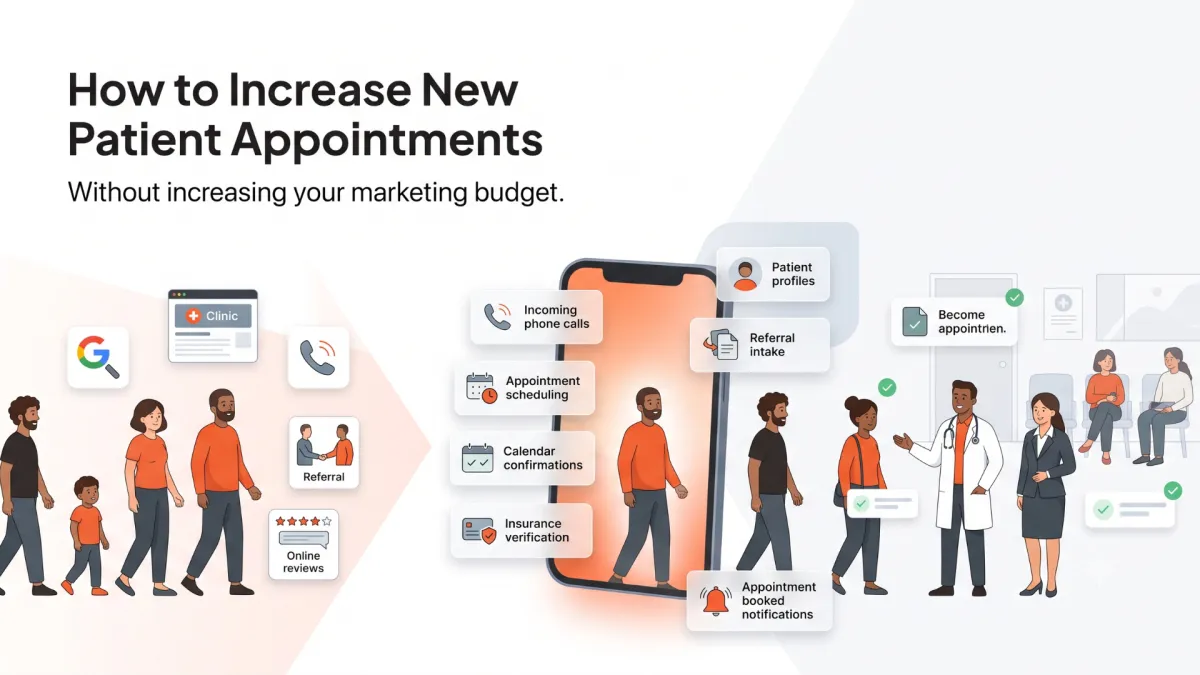
Increase New Patient Appointments Without Marketing Spend
You may not need more leads to grow your practice. You may need to convert more of the callers, website visitors, and referrals you already receive. By answering every call, reducing hold times, improving scheduling, following up quickly, and making it easier for patients to book, practices can increase new patient appointments without spending more on marketing.
Most medical practices assume that attracting more new patients requires spending more on marketing.
More Google Ads.
More social media.
More search engine optimization.
More referral campaigns.
More money.
But many practices already generate enough interest to grow.
The problem is that too many potential patients are lost after they call.
Some reach voicemail.
Some wait on hold.
Some never receive a callback.
Others cannot find an appointment time quickly enough and call another practice instead.
This means the fastest way to increase new patient appointments may not be to increase your marketing budget.
It may be to convert more of the patient inquiries you already receive.
When your practice answers more calls, responds faster, and makes scheduling easier, the same marketing investment can produce significantly more appointments.
Start by Looking at the Patient Journey
Every new patient moves through a series of steps before an appointment is booked.
They may:
Search for a physician online
Visit your website
Read your reviews
Check your accepted insurance plans
Call your office
Ask about availability
Schedule an appointment
Most practices focus heavily on the first few steps.
They invest in visibility.
They work to rank higher on Google.
They build a professional website.
They collect positive reviews.
But the final steps are often neglected.
A patient may be interested in your practice, trust your reputation, and be ready to schedule.
Then no one answers the phone.
The appointment is lost at the moment when the patient was closest to converting.
More Leads Do Not Always Mean More Appointments
Marketing generates opportunities.
It does not guarantee appointments.
Imagine two practices receiving the same number of new patient inquiries each month.
Practice A answers most calls immediately, offers convenient appointment times, and completes scheduling during the first conversation.
Practice B sends many calls to voicemail, returns messages later, and requires several conversations before an appointment is confirmed.
Practice A will likely book more patients even though both practices spend the same amount on marketing.
The difference is not lead generation.
It is lead conversion.
Answer More New Patient Calls
For many medical practices, the phone remains the most important conversion channel.
New patients often want to speak with someone before booking.
They may need to ask:
Do you accept my insurance?
Are you accepting new patients?
How soon can I be seen?
Do I need a referral?
Which provider should I schedule with?
What should I bring to the appointment?
When these calls go unanswered, patients may not wait.
They often contact the next practice in their search results.
Answering more calls allows your practice to capture more value from the marketing you are already paying for.
Reduce Hold Times
Even when someone answers, a long hold can still cost you the appointment.
New patients are often less patient than established patients because they do not yet have a relationship with your practice.
They may be comparing several offices.
They may be calling during a short break at work.
They may need an appointment quickly.
If your front desk is busy helping patients in person, processing referrals, or managing insurance questions, callers may wait several minutes before receiving help.
Some will hang up.
Reducing hold times can improve appointment conversion without generating a single additional lead.
Make Scheduling Easier
The more difficult it is to schedule, the more opportunities your practice loses.
Common barriers include:
Limited phone availability
Long callback times
Repeated transfers
Complex appointment rules
Too few appointment options
Staff uncertainty about scheduling
Requiring patients to call back later
Patients expect convenience.
When possible, the appointment should be scheduled during the first conversation.
If the patient must wait for a callback, repeat information, or contact another department, the chance of losing them increases.
Offer the Earliest Appropriate Appointment
New patients often choose the practice that can see them soonest.
This does not mean every caller needs a same-day appointment.
It means your scheduling process should identify the earliest appropriate option quickly.
Practices can improve this by:
Keeping scheduling rules current
Offering alternative providers
Offering alternative locations
Using cancellation openings
Maintaining a waitlist
Offering telemedicine when appropriate
Making new patient availability easy to identify
When staff struggle to find the right appointment, callers may assume the practice has no availability.
Follow Up on Missed Calls Quickly
Not every call will be answered.
Staff may be helping a patient.
The office may be closed.
Call volume may spike unexpectedly.
What matters is what happens next.
A missed call should trigger a clear follow-up process.
The practice should know:
Who called
When they called
Whether they left a message
Whether they were a potential new patient
Who is responsible for calling back
How quickly the callback should occur
The longer the delay, the more likely the patient is to schedule somewhere else.
A callback several hours later may already be too late.
Improve Your Voicemail Process
Voicemail should not become a holding area where potential patients wait indefinitely.
If your practice relies on voicemail, the message should clearly explain:
When the patient can expect a callback
Whether online scheduling is available
What information they should leave
What to do for urgent concerns
Whether there is an after-hours option
The practice should also review voicemail frequently and prioritize new patient inquiries.
However, voicemail is still less effective than immediate assistance.
Many patients prefer not to leave a message at all.
Train Staff to Recognize High-Intent Calls
Not every caller is equally likely to schedule.
A patient asking about office hours may simply be gathering information.
A patient asking about the earliest new patient appointment is showing strong intent.
Your staff should recognize calls that are close to becoming appointments.
Examples include:
New patient availability
Insurance acceptance
Referral requirements
Provider selection
Appointment cost
Earliest appointment date
Location questions
Specific symptoms or services
These callers should receive fast, confident assistance.
Uncertainty or repeated transfers can reduce trust and lead to lost appointments.
Make Insurance Information Easy to Access
Insurance questions often determine whether a new patient schedules.
If front desk staff cannot quickly confirm whether the practice accepts a plan, the caller may move on.
Practices should maintain an accurate, easy-to-access list of accepted insurance plans.
Staff should also know how to explain the difference between:
Accepting an insurance plan
Being in network
Requiring a referral
Needing prior authorization
Verifying patient benefits
Clear information helps patients make decisions faster.
Improve New Patient Call Scripts
Front desk conversations should feel natural, not scripted.
However, a consistent structure can improve conversion.
A strong new patient call may include:
A warm greeting
Confirmation that the practice is accepting new patients
A few questions about the reason for the visit
Insurance or referral clarification
Appointment options
Confirmation of contact information
Clear next steps
Without a consistent process, important questions may be missed.
The patient may be told to call back or may leave the conversation unsure what to do next.
Reduce Unnecessary Transfers
Every transfer creates friction.
Patients may be placed on hold again.
They may need to repeat their information.
The call may be disconnected.
The next staff member may not be available.
Whenever possible, the first person or system answering the call should complete the request.
When a transfer is necessary, the caller should be sent to the correct destination the first time.
Reducing transfers improves both patient satisfaction and appointment conversion.
Extend Your Availability Beyond Office Hours
Many patients search for care outside normal business hours.
They may call:
Before work
During lunch
After work
In the evening
On weekends
If your practice only answers calls from 8 AM to 5 PM, many high-intent inquiries may reach voicemail.
By the time your staff returns the call, the patient may already have scheduled elsewhere.
Providing immediate assistance after hours can help your practice convert inquiries that would otherwise be lost.
Use Online Scheduling Carefully
Online scheduling can make booking more convenient.
But it should support the phone experience, not replace it entirely.
Some patients prefer to book online.
Others need help deciding:
Which provider to choose
Which appointment type is correct
Whether a referral is required
Whether the practice accepts their insurance
How soon they should be seen
A strong patient access strategy gives patients multiple ways to schedule while ensuring that each option is simple and accurate.
Use Your Existing Referral Network More Effectively
Many practices already receive referrals from physicians, urgent care centers, hospitals, or community organizations.
But referrals do not always become appointments.
Common problems include:
Referral paperwork is incomplete
Patients are not contacted quickly
Calls go unanswered
Scheduling takes several attempts
The patient does not understand the next step
The referral is sent to the wrong location
Improving referral follow-up can increase new patient volume without spending more on advertising.
The opportunity already exists.
The practice simply needs a more reliable process for converting it.
Track Where New Patient Calls Are Lost
You cannot improve what you do not measure.
Practices should review:
Number of new patient calls
Calls answered
Calls missed
Average hold time
Abandoned calls
Appointment conversion rate
Time to callback
Reasons patients did not schedule
Appointment availability
Calls received after hours
These metrics reveal where the patient journey breaks down.
For example, a practice may discover that it receives enough inquiries but loses many callers during lunch or after 4 PM.
That is an operational problem, not a marketing problem.
Calculate Your New Patient Conversion Rate
A simple conversion rate can help you understand performance.
Divide the number of new patient appointments booked by the number of new patient inquiries received.
For example:
If your practice receives 200 new patient inquiries and books 100 appointments, your conversion rate is 50%.
If you improve the conversion rate to 65%, you book 130 appointments from the same number of inquiries.
That is 30 additional appointments without increasing your marketing budget.
Even small improvements can create meaningful growth.
Improve Appointment Availability Without Adding Providers
Sometimes the issue is not phone access.
It is appointment capacity.
Practices can often improve availability by reviewing how the schedule is structured.
Potential opportunities include:
Reserving slots for new patients
Reducing unused appointment blocks
Releasing held appointments earlier
Using cancellation waitlists
Offering alternate providers
Reviewing appointment duration
Expanding telemedicine options
Identifying recurring schedule gaps
The goal is not to overbook.
It is to make better use of the availability you already have.
Reduce No-Shows
Booking more appointments is only valuable when patients attend.
A strong new patient process should include:
Appointment confirmation
Clear directions
Parking information
Required forms
Insurance instructions
Referral requirements
Reminder messages
Easy rescheduling
Patients are more likely to attend when they know exactly what to expect.
Reducing no-shows allows your existing marketing and scheduling efforts to produce more completed visits.
Improve Your Online Information
Sometimes patients call because they cannot find basic information online.
Your website and Google Business Profile should clearly display:
Office hours
Phone number
Location
Accepted insurance plans
Services offered
Providers
Whether you are accepting new patients
Scheduling options
Referral requirements
Accurate information reduces unnecessary calls while helping high-intent patients make decisions faster.
It also prevents staff from repeatedly answering the same questions.
Ask Why Patients Did Not Schedule
Not every caller will book.
But the reason matters.
Patients may decline because:
The appointment was too far away
Their insurance was not accepted
They needed a different specialty
The location was inconvenient
They were transferred too many times
They did not receive a callback
They were still comparing practices
Tracking these reasons helps your team identify patterns.
Some issues cannot be changed.
Others may be easy to fix.
Support Your Front Desk Instead of Blaming Them
When new patient calls are lost, it is easy to assume the front desk is underperforming.
In reality, many receptionists are overwhelmed.
They may be responsible for:
Answering phones
Checking patients in
Collecting payments
Verifying insurance
Processing referrals
Handling medical records
Supporting clinical staff
Managing patient complaints
The problem is often not effort.
It is capacity.
Improving systems, workflows, and automation can help staff convert more calls without increasing stress.
How AI Receptionists Improve New Patient Conversion
An AI receptionist can help practices capture more value from existing patient demand.
Instead of allowing calls to reach voicemail, AI can answer immediately.
Depending on the practice’s workflow, it can:
Identify new patients
Answer common questions
Explain accepted insurance information
Collect referral details
Offer appointment options
Schedule directly into supported EMRs
Handle several calls at once
Respond outside normal office hours
Generate call summaries
Escalate complex situations to staff
This improves access without requiring the practice to spend more on advertising.
The marketing has already done its job.
The AI helps ensure the opportunity is not lost.
How Zaya Helps Practices Book More New Patients
Zaya is designed specifically for independent medical practices.
It works alongside your front desk to improve patient access and reduce repetitive phone work.
With Zaya, practices can:
Answer calls 24 hours a day
Handle multiple callers simultaneously
Schedule appointments in supported EMRs
Follow practice-specific scheduling rules
Answer frequently asked questions
Identify new patient inquiries
Collect insurance and referral information
Handle appointment changes
Support multilingual conversations
Create structured call summaries
Zaya helps your practice convert more of the demand you already generate without requiring a larger marketing budget or additional front desk staff.
Frequently Asked Questions
Do I need to spend more on marketing to get more new patients?
Not necessarily. Many practices already receive enough inquiries but lose patients because calls go unanswered, hold times are too long, or scheduling is difficult. Improving conversion may generate more appointments without increasing marketing spend.
What is a new patient conversion rate?
It is the percentage of new patient inquiries that result in booked appointments. Tracking this rate helps practices understand whether they are converting existing demand effectively.
Why do new patients call another practice?
Common reasons include unanswered calls, long hold times, delayed callbacks, limited appointment availability, confusing scheduling processes, and uncertainty about insurance.
Can an AI receptionist schedule new patients?
Yes. When integrated with a supported EMR or scheduling system, an AI receptionist can offer available appointment times and schedule patients according to the practice’s rules.
Will AI replace my front desk staff?
No. AI is most useful for handling repetitive calls, after-hours inquiries, and routine scheduling so staff can focus on in-person patients and more complex responsibilities.
How quickly should missed calls be returned?
As quickly as possible. New patients may be contacting several practices, so even a short delay can reduce the chance of booking the appointment.
Grow by Converting More of What You Already Have
Increasing your marketing budget can generate more patient inquiries.
But sending more inquiries into a broken scheduling process will not solve the underlying problem.
Before spending more, examine what happens after patients contact your practice.
Are calls answered?
Are hold times reasonable?
Can patients schedule during the first conversation?
Are missed calls returned quickly?
Is after-hours support available?
Can staff easily explain insurance and referral requirements?
Improving these areas can produce more new patient appointments from the same marketing investment.
The most effective growth strategy may not be attracting more people.
It may be making it easier for the people already interested in your practice to become patients.
Talk to Zaya
Experience the difference. Tap the microphone to start a natural conversation with our AI right now.
You'll need to allow microphone access to start the demo.