
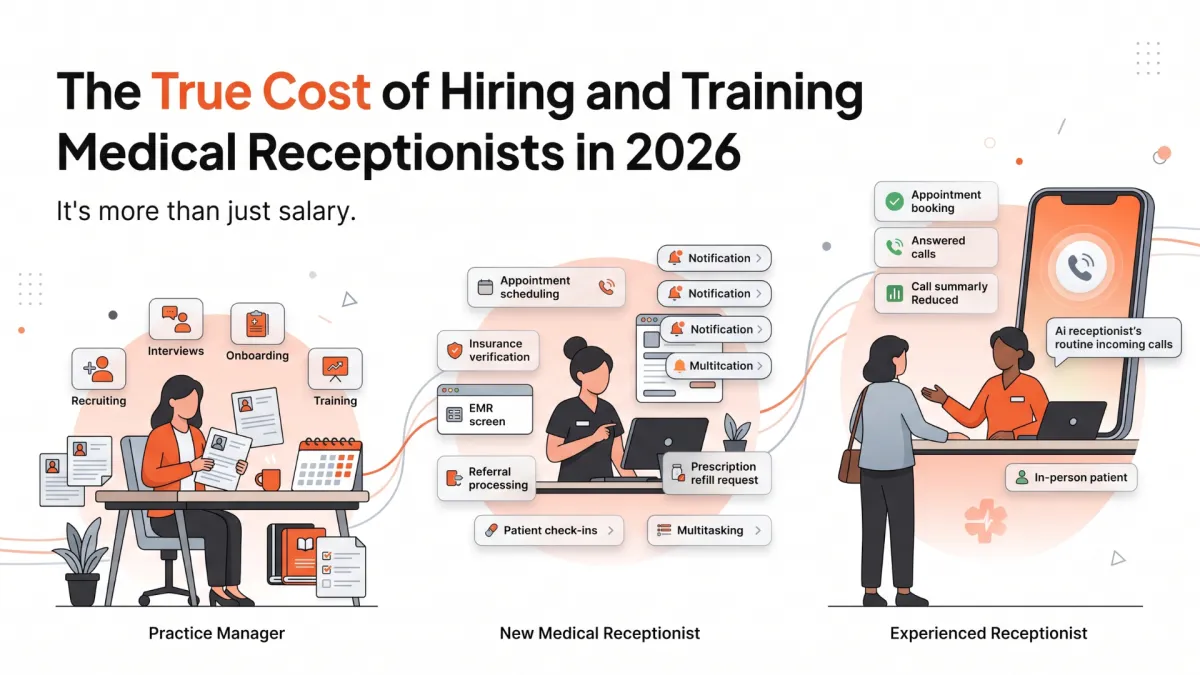
The True Cost of Hiring and Training Medical Receptionists in 2026
The cost of hiring a medical receptionist in 2026 goes well beyond wages. Recruitment, benefits, onboarding, training, turnover, and lost productivity significantly increase the total investment. Understanding these hidden costs can help practices make more informed staffing decisions and evaluate whether automation can reduce administrative workload before hiring additional employees.
Hiring another medical receptionist often feels like the obvious solution when your front desk is overwhelmed.
The phones keep ringing.
Patients are waiting on hold.
Existing staff are stretched thin.
Adding another employee seems like the fastest way to improve service.
But in 2026, the true cost of hiring a medical receptionist extends far beyond the advertised salary.
Recruiting, onboarding, training, benefits, turnover, and ongoing management all add to the total investment.
Before deciding to grow your front desk team, it's worth understanding what hiring really costs and whether there are other ways to increase capacity without increasing payroll.
The Front Desk Has Never Been More Demanding
Medical receptionists do far more than answer phones.
A typical day may include:
Answering incoming calls
Scheduling appointments
Checking patients in
Collecting copays
Verifying insurance
Managing referrals
Processing prescription refill requests
Coordinating medical records
Responding to portal messages
Supporting providers and clinical staff
Every interruption requires them to shift focus.
As patient expectations continue to rise, the workload has become increasingly difficult to manage.
Salary Is Only the Beginning
When practices budget for a new receptionist, they often focus on salary alone.
However, compensation is only one part of the total cost.
Additional expenses may include:
Payroll taxes
Health insurance
Retirement contributions
Paid time off
Workers' compensation
Training costs
Recruiting expenses
Uniforms and equipment
Office space
Computer hardware
Software licenses
The actual cost of employing a receptionist is often substantially higher than the advertised wage.
Recruiting Takes Time
Finding qualified front desk staff has become increasingly challenging.
Practices often spend weeks or months:
Writing job descriptions
Advertising positions
Reviewing resumes
Conducting interviews
Checking references
Negotiating offers
Completing background checks
During this period, existing staff continue carrying the additional workload.
Hiring delays can increase burnout across the entire team.
Training Is a Significant Investment
Even experienced receptionists require training.
Every medical practice has unique:
Scheduling rules
EMR workflows
Insurance processes
Phone etiquette
Provider preferences
Appointment types
Referral procedures
Office policies
Training often requires experienced employees to step away from their own responsibilities.
Productivity temporarily decreases while new staff learn the practice.
New Employees Rarely Reach Full Productivity Immediately
Most new hires require weeks or months before becoming fully independent.
During this period they may need assistance with:
Scheduling complex appointments
Insurance verification
Referral workflows
Provider-specific preferences
EMR navigation
Escalation procedures
Existing staff continue providing supervision while managing their normal workload.
Turnover Is Expensive
Front desk turnover remains one of the biggest operational challenges for many practices.
When an employee leaves, the practice loses:
Experience
Workflow knowledge
Provider familiarity
Patient relationships
The hiring process begins again.
Repeated turnover creates recurring recruitment and training costs while disrupting patient service.
Burnout Increases Hidden Costs
Medical receptionists frequently manage constant interruptions.
Phones ring continuously.
Patients arrive at the front desk.
Providers need assistance.
Insurance companies call.
Prescription requests accumulate.
This environment contributes to workplace stress.
Burnout can lead to:
Increased absenteeism
Lower morale
Reduced productivity
Higher turnover
More hiring
Reducing repetitive work can be just as valuable as adding more staff.
More Staff Doesn't Always Solve the Problem
Hiring another receptionist increases capacity.
It does not eliminate inefficiency.
Many incoming calls involve repetitive requests such as:
Appointment scheduling
Office hours
Insurance questions
Prescription refill requests
Directions
Appointment confirmations
Rescheduling
If these repetitive conversations continue growing, practices may eventually need to hire again.
The cycle repeats.
The Opportunity Cost of Constant Phone Calls
Every time the phone rings, the receptionist stops another task.
They may interrupt:
Patient check-in
Insurance verification
Referral processing
Billing
Administrative work
These interruptions reduce efficiency throughout the day.
Even with additional staff, frequent task switching continues.
Patients Expect Immediate Service
Today's patients compare healthcare with every other service they use.
They can:
Order groceries instantly
Reserve hotels online
Schedule rides in seconds
Book restaurant reservations immediately
When they call a medical office, they expect someone to answer.
Long hold times and voicemail create frustration regardless of how many employees are working.
Technology Can Reduce Administrative Work
Modern automation allows practices to reduce repetitive front desk tasks without reducing patient service.
AI can assist with:
Appointment scheduling
Appointment changes
Frequently asked questions
Prescription refill requests
Insurance information
Referral collection
Call routing
After-hours support
Call summaries
This allows receptionists to spend more time helping patients who truly need human assistance.
Hiring and Automation Are Not Opposites
Many practice owners assume they must choose between hiring staff or using AI.
In reality, the two often work together.
Practices may still hire receptionists.
The difference is that those employees spend less time answering repetitive phone calls and more time on:
Patient interactions
Complex scheduling
Insurance issues
Clinical coordination
Administrative responsibilities
Technology increases the productivity of existing staff.
When Hiring Makes Sense
There are situations where adding staff is absolutely appropriate.
Examples include:
Opening a new location
Significant patient growth
Expanded clinical services
Longer office hours
Increased in-person patient volume
Hiring supports business growth.
The question is whether the new employee will spend most of their day performing tasks that technology can already assist with.
Calculate the Return on Investment
Before hiring, practices should ask:
How many calls are we missing?
How many appointments are we losing?
How much staff time is spent on repetitive questions?
How often are patients placed on hold?
How much overtime is being paid?
Could automation reduce enough work to delay another hire?
These questions help determine the most cost-effective solution.
The Cost of Doing Nothing
Sometimes the biggest expense isn't hiring.
It's maintaining the status quo.
Missed calls can result in:
Lost new patients
Lower patient satisfaction
Increased staff stress
More overtime
Negative online reviews
Reduced practice growth
Operational inefficiencies become increasingly expensive over time.
How Zaya Helps Practices Increase Capacity
Zaya was built specifically for independent medical practices.
Instead of replacing receptionists, Zaya helps practices reduce repetitive administrative work while ensuring every patient receives prompt assistance.
With Zaya, practices can:
Answer calls 24/7
Handle multiple callers simultaneously
Schedule appointments directly into supported EMRs
Process appointment changes
Answer common patient questions
Collect prescription refill requests
Route urgent calls appropriately
Support multilingual conversations
Generate structured call summaries
This allows existing staff to focus on higher-value work while improving the patient experience.
Frequently Asked Questions
What is the biggest hidden cost of hiring a receptionist?
Beyond salary, practices must consider recruiting, onboarding, training, benefits, payroll taxes, technology, workspace, and the productivity lost while new employees learn the role.
How long does it take to train a new medical receptionist?
The timeline varies by practice, but most receptionists require several weeks or months before becoming fully comfortable with scheduling rules, EMR workflows, insurance processes, and office procedures.
Should practices stop hiring because of AI?
No. AI is designed to support receptionists, not replace them. It handles repetitive administrative conversations so staff can focus on patients and more complex responsibilities.
Can AI reduce front desk workload?
Yes. AI can answer routine calls, schedule appointments, process appointment changes, collect refill requests, answer frequently asked questions, and support patients after hours.
How do I know if my practice needs another receptionist?
Review your call volume, missed calls, patient growth, overtime, hold times, and staff workload. In many cases, improving workflows and automating repetitive tasks can increase capacity before another hire becomes necessary.
Invest in Capacity, Not Just Headcount
Hiring another receptionist may be the right decision for your practice.
But it should be based on operational need, not simply because the phones keep ringing.
Understanding the full cost of hiring helps practices make better long-term decisions.
Sometimes the best investment is another employee.
Sometimes it's improving the productivity of the team you already have.
By reducing repetitive administrative work, improving patient access, and answering every call, practices can often increase capacity without continually increasing payroll.
For many independent medical practices, that's exactly where AI receptionists like Zaya provide the greatest value.
Talk to Zaya
Experience the difference. Tap the microphone to start a natural conversation with our AI right now.
You'll need to allow microphone access to start the demo.