
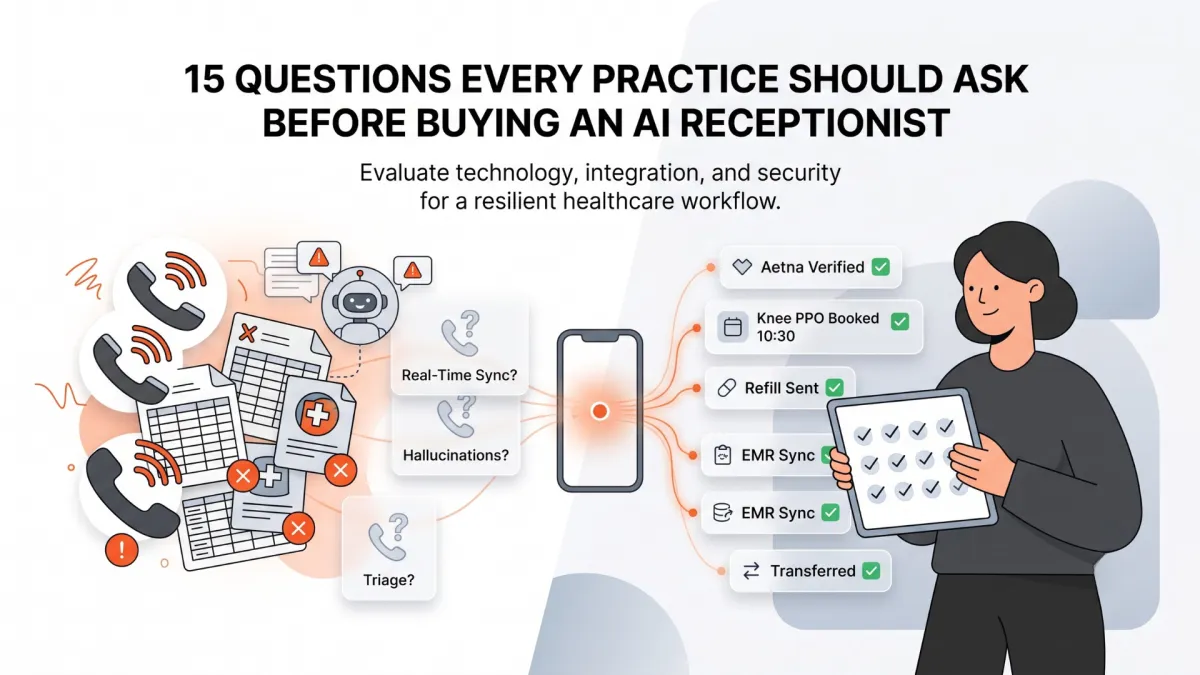
Why Most Medical Practices Choose the Wrong AI Receptionist?
Adopting an AI receptionist can eliminate phone hold times and capture lost appointment revenue, but choosing the wrong solution risks calendar errors, HIPAA compliance breaches, and frustrated patients. Medical practices must look past polished vendor demos and systematically evaluate potential platforms across technical capability, EMR integration depth, clinical safety protocols, and operational workflows. By asking fifteen targeted questions about real-time EMR write-backs, hallucination safeguards, edge-case call transfers, and cost structures, practice leaders can select an AI partner that genuinely supports front desk staff and protects patient care.
Managing patient phone calls is one of the most persistent operational burdens for independent medical practices. Front desk staff are pulled in multiple directions at once, forced to split their attention between in-person patient check-ins and an endlessly ringing multi-line phone system.
When inbound call volume exceeds front office bandwidth, administrative friction accumulates quickly. Patients face long hold times, calls go straight to voicemail, and appointment scheduling delays cause prospective patients to contact rival practices down the street.
To solve phone bottlenecks, many practice owners and operations leaders are evaluating voice artificial intelligence. An AI receptionist promises to answer every inbound call instantly, operate around the clock, and integrate with electronic medical records to schedule appointments automatically.
However, selecting an AI receptionist platform requires careful technical and operational due diligence. Sales demos often present an idealized environment that fails to reflect the complexity of real-world patient interactions, EMR integration nuances, and clinical protocols.
Asking the right questions during vendor evaluations is critical to protecting patient safety, maintaining data compliance, and ensuring a smooth front office workflow.
The Growing Pressure on Front Office Operations
Front office phone management in independent medical practices has reached a critical tipping point. Inbound call volumes are higher than ever, while staffing shortages and administrative overhead continue to squeeze practice margins.
Call volume in a medical office is volatile. Inbound phone calls arrive in sudden, concentrated bursts during peak hours—first thing in the morning, immediately after lunch, and right before clinic closing.
Human receptionists cannot scale their capacity instantaneously to handle dozens of incoming lines during a peak morning surge. When three calls ring simultaneously while a line of patients stands in the waiting room, front desk staff must make a choice.
Etiquette dictates prioritizing the physical patient standing at the counter. As a result, phone calls are placed on extended holds, routed to voicemail boxes, or abandoned entirely.
This constant operational stress leads to predictable negative outcomes:
High staff turnover and burnout driven by chronic multitasking friction.
Increase in patient no-shows due to difficult scheduling processes.
Missed referral opportunities from primary care physicians.
Accumulation of administrative voicemails requiring hours of end-of-day callbacks.
Solving this front office bottleneck requires moving beyond traditional call forwarding, answering services, or static interactive voice response phone trees.
Why Legacy Call Solutions No Longer Work
For decades, medical practices relied on two primary methods to manage phone overflow: traditional medical answering services and automated press-button phone trees.
Traditional answering services rely on third-party call center operators reading basic, static scripts. While an answering service can take a message after hours, operators cannot view live provider calendars, verify insurance details, or book appointments directly inside your EMR.
Every call handled by a traditional answering service simply converts an immediate phone call into a delayed administrative task. Your internal staff must still spend hours playing phone tag the following morning to confirm bookings or answer basic clinical inquiries.
On the other hand, interactive voice response phone trees alienate callers. A patient dealing with acute symptoms or attempting to reschedule a consultation does not want to navigate a multi-tiered menu requiring numeric button inputs.
Modern patient communication demands immediate, natural conversational interactions. Patients expect to speak naturally, receive instant answers, and resolve their scheduling or administrative needs in a single call.
The Risk of Buying AI Technology Without Due Diligence
Voice AI has evolved rapidly, making conversational phone interactions remarkably smooth and human-like. However, deploying AI technology in a healthcare environment carries unique responsibilities that do not exist in standard commercial industries.
A standard voice bot used for retail order tracking or hotel bookings operates under simple rules with minimal clinical risk. In contrast, a medical practice phone receptionist processes protected health information, triages urgent medical symptoms, and enforces complex clinical scheduling logic.
Purchasing an AI receptionist platform without rigorous vetting can introduce severe operational liabilities into your practice:
Unintegrated systems booking appointments into incorrect calendar slots or double-booking providers.
AI models fabricating information or promising clinical care options your practice does not offer.
System failures during network outages that leave callers stranded without emergency routing.
Hidden per-minute usage fees that inflate software invoices far beyond initial budget projections.
Security gaps that expose protected health information and violate HIPAA regulations.
To avoid these pitfalls, practice leaders must conduct thorough vendor evaluations. Evaluating voice AI platforms requires asking deep, practical questions that examine technical architecture, clinical safeguards, and financial sustainability.
15 Essential Questions to Ask Before Choosing an AI Receptionist
Before signing a contract or starting an implementation project, ask prospective AI receptionist vendors the following fifteen questions.
1. Does the AI Write Appointments Directly to Our EMR Calendar in Real Time?
Many AI platforms claim to offer EMR integration, but their actual functionality varies widely. Some systems only offer one-way read access or generate email notifications containing appointment details that your human staff must manually type into your software later.
True integration requires real-time, bi-directional write capability through secure application programming interfaces. The AI must be able to query live provider calendars, check open slots, enforce provider visit rules, and lock the appointment directly onto the EMR calendar within seconds during the phone call.
If an AI vendor relies on asynchronous message delivery or manual staff confirmation, it does not solve your scheduling bottleneck. It merely transfers data entry from a phone call to an inbox.
2. How Does the AI Enforce Complex, Provider-Specific Scheduling Rules?
Clinical scheduling is rarely a simple matter of finding an open fifteen-minute window. Every physician maintains unique preferences regarding schedule structure, visit type durations, buffer times, and daily patient caps.
Ask the vendor to explain how their system configures and enforces complex scheduling parameters. For example:
Can the AI distinguish between a 30-minute new patient consultation and a 15-minute follow-up?
Can it restrict specialized procedures to specific days when equipment is available?
Can it enforce daily limits on specific visit types to prevent provider burnout?
Can it calculate buffer times following minor surgical procedures?
A robust healthcare AI receptionist must execute these nuanced rules with absolute precision on every single call.
3. What Safeguards Prevent the AI From Fabricating Information?
Generative AI models are capable of producing logical but factually incorrect statements, commonly known as hallucinations. In a medical setting, an AI hallucination could mean telling a patient that a physician treats conditions outside their scope or giving incorrect pre-procedure instructions.
Inquire about the technical architecture used to ground the AI's knowledge base. The vendor should utilize strict retrieval-augmented generation and deterministic business logic that limits the AI's responses exclusively to your practice's approved clinical guidelines and administrative protocols.
Ask the vendor directly: What happens when a patient asks a question that is not covered in our approved practice documentation? The AI must admit it does not know the answer and gracefully transfer or log the inquiry rather than guessing.
4. How Does the System Handle Clinical Emergencies and Urgent Symptom Triage?
When a patient calls a medical clinic, their condition may be more urgent than a routine scheduling request. A caller complaining of chest pain, severe shortness of breath, sudden vision changes, or post-operative bleeding requires immediate clinical intervention.
Ask the vendor to demonstrate their emergency escalation and symptom triage protocols. The system must continuously monitor conversations for critical red-flag keywords and clinical phrases.
When an emergency keyword is detected, the AI must immediately pause routine administrative processing and execute practice-defined safety protocols, such as warm-transferring the caller to an on-call nurse or instructing the caller to dial 911.
5. What Happens When the AI Encounter an Unrecognized Scenario?
No automated platform can resolve 100% of human interactions. Patients frequently present complex, unmapped situations, such as complicated insurance billing disputes, nuanced clinical questions, or emotional distress.
Ask the vendor to detail their edge-case handling and call transfer architecture:
Does the system offer immediate live call transfers to internal front desk lines or on-call staff?
What happens if the live transfer line is busy or unanswered?
How does the AI summarize and route the unhandled inquiry to your staff?
A reliable AI platform must recognize its own operational boundaries and maintain a clean escalation path back to human team members when a conversation exceeds its capabilities.
6. How Does the System Prevent Duplicate Patient Records in Our EMR?
When a returning patient calls to schedule a visit, creating a duplicate record inside your EMR database creates administrative chaos and fragments clinical history.
Ask how the AI identifies callers and links new bookings to existing patient files. The system should gather key identifiers—such as full legal name, date of birth, primary phone number, and address—and perform a real-time database lookup against your EMR.
If a matching record is located, the AI must attach the appointment directly to the existing chart. If no match exists, it should follow standardized formatting rules to create a clean, non-duplicate patient file.
7. Is the Platform Fully HIPAA Compliant, and Will You Sign a Business Associate Agreement?
Data security and regulatory compliance are non-negotiable in healthcare technology. Any vendor handling protected health information must operate under strict privacy standards.
Ensure the vendor provides a formal Business Associate Agreement before collecting any practice data. Additionally, verify their underlying security standards:
Is all data encrypted both in transit and at rest using modern standards like TLS 1.2+ and AES-256?
Where is patient data stored, and who has access to call recordings and transcripts?
Are patient phone calls or clinical data used to train public AI models?
A trustworthy healthcare technology vendor will explicitly guarantee that your practice's data remains isolated and is never shared or used for external model training.
8. How Does the AI Collect and Validate Insurance Information?
Insurance coverage inquiries represent a high volume of daily front desk calls. Patients routinely ask whether a practice is in-network or what information is required before booking.
Ask the vendor how the AI receptionist handles insurance workflows:
Can the AI cross-reference a caller's insurance plan against your practice's accepted payer list?
How does it collect structured subscriber IDs, group numbers, and policyholder details during intake?
Can it inform callers when a specific plan requires a primary care referral before scheduling?
Automating initial insurance data collection prevents front desk bottlenecks and lowers downstream billing rejections caused by missing coverage details.
9. How Does the System Manage Prescription Refill Intake?
Medication renewals are a major driver of daily phone traffic. Managing refills manually involves endless phone tag between receptionists, patients, pharmacies, and clinical care teams.
Ask the vendor to walk through their automated prescription refill workflow:
Does the AI collect structured, mandatory details, including drug name, exact strength, dosage, and pharmacy location?
Can it ask practice-approved clinical pre-screening questions, such as confirming recent lab work or office visits?
How does it deliver the gathered refill data to your clinical team?
Capturing clean, complete refill details over the phone allows nurses and physicians to review and authorize renewals quickly without making unnecessary verification callbacks.
10. Can the AI Switch Seamlessly Between Multiple Languages?
In many communities, serving a diverse demographic requires clear, multilingual phone support. Relying on third-party translation lines or specific bilingual staff members creates scheduling delays and extends hold times.
Ask the vendor about language capabilities and conversational switching mechanics:
Which languages does the platform support natively?
Can the AI detect the caller's language automatically and switch instantly without requiring manual menu selections?
Are provider scheduling rules, practice policies, and pre-visit instructions communicated accurately across all supported languages?
Providing native multilingual phone support expands patient access and ensures clear communication for all patients across your community.
11. How Does the AI Deliver Call Summaries and Transcripts to Practice Staff?
Even when an AI receptionist handles a call completely, your front office and clinical staff need clear visibility into what transpired during the interaction. Listening to full call recordings is time-consuming and inefficient.
Ask the vendor to display their call summary dashboard and EMR integration outputs:
Does the AI generate structured, concise written summaries of every call?
Are summaries delivered directly into your EMR inbox or practice management system?
Does the summary highlight actionable tasks, such as required follow-ups or prescription authorizations?
Clean, automated call summaries allow staff to understand patient needs in seconds without sifting through long recordings or unstructured notes.
12. What Is the Real Total Cost of Ownership and Pricing Structure?
Software pricing in healthcare technology can sometimes be confusing, with hidden usage fees that make budgeting difficult.
Inquire about the vendor's exact pricing framework and evaluate potential secondary fees:
Is pricing structured as a predictable flat monthly fee, or are charges calculated per minute of call time?
Are there additional fees for EMR integration maintenance, custom protocol changes, or software updates?
What are the setup costs, and are there long-term contract lock-ins?
A predictable flat-rate model allows independent practices to scale call volumes during busy seasons without facing unexpected monthly invoice spikes.
13. What Does the Implementation and Onboarding Process Look Like?
Busy medical practices do not have the internal technical bandwidth to manage complex software deployment projects. Implementation should be straightforward, structured, and minimally disruptive to daily operations.
Ask the vendor about their standard onboarding timeline and resource requirements:
How long does deployment take from contract signing to live call handling?
How much time is required from your practice managers and physicians to configure rules?
Does the vendor handle EMR mapping and phone carrier forwarding configurations?
A mature healthcare AI vendor provides dedicated implementation specialists who manage configuration, EMR mapping, and testing on your behalf.
14. How Does the Platform Perform During Unexpected Call Spikes or Outages?
System reliability is critical when managing primary practice phone lines. If an AI system experiences downtime during a peak morning rush, inbound calls must be protected.
Ask the vendor about technical redundancy and failover infrastructure:
What is the platform's historical uptime record and service level agreement?
What happens if your practice's local internet connection or internal phone lines go down?
How does the system handle catastrophic telecom failures or regional network outages?
The platform should feature automatic failover protocols that forward calls to backup human lines or emergency voicemail systems if a network disruption occurs.
15. How Is System Performance Monitored and Audited Over Time?
Deploying an AI receptionist is not a one-time event; it requires ongoing performance visibility to ensure long-term operational success and compliance.
Ask what analytics, reporting tools, and auditing capabilities are available to practice administrators:
Can you review metrics on call volume, handle times, resolution rates, and transfer reasons?
Is there a searchable archive of call transcripts and audio recordings for quality assurance?
How does the vendor handle model updates and system performance optimization as your practice grows?
Having full access to operational data allows practice leaders to measure return on investment, identify front office trends, and refine practice protocols over time.
The Tangible Benefits of Selecting the Right AI Partner
When an independent medical practice carefully evaluates vendors and deploys a robust, EMR-integrated AI receptionist, the operational improvements are immediate.
Elimination of Hold Times Calls are answered instantly on the first ring, day or night. Patients receive immediate assistance without enduring extended holds or reaching full voicemail boxes.
Continuous 24/7/365 Scheduling Patients gain the ability to book, reschedule, or cancel appointments after hours and on weekends, capturing appointment demand that would otherwise be lost to competitors.
Restored Front Desk Bandwidth Offloading high-volume, routine phone interactions frees front office staff to concentrate on welcoming arriving patients, processing authorizations, and managing complex care needs in person.
Improved Financial Performance Higher appointment capture rates, reduced no-shows through immediate self-service rescheduling, and lowered administrative overhead combine to create strong practice financial health.
How to Choose the Right AI Receptionist for Your Medical Practice with Zaya
Evaluating an AI receptionist is about more than comparing features. Your practice needs a solution that supports real-world front office workflows, integrates with your EMR, and helps staff manage patient calls without adding unnecessary complexity.
Zaya is built specifically for independent medical practices and is designed around the same evaluation criteria covered in this guide. Rather than relying on manual message taking or disconnected scheduling workflows, Zaya helps practices streamline routine phone operations while keeping patients connected to accurate, practice-approved information.
With Zaya, your practice can:
Answer every inbound call without long hold times or missed opportunities.
Schedule, reschedule, and cancel appointments using live EMR availability and your practice's scheduling rules.
Collect structured information for prescription refill requests and other routine administrative calls.
Generate clear call summaries so your team can quickly review interactions and follow up when needed.
Support multilingual conversations and after-hours call handling to improve patient access.
If you're comparing AI receptionist vendors, use the 15 questions in this guide as your evaluation framework. They can help you determine whether a solution is capable of supporting your clinical workflows, protecting patient information, and reducing the administrative burden on your front office.
Frequently Asked Questions
Why should medical practices ask detailed questions before choosing an AI receptionist?
An AI receptionist becomes part of your daily front office operations, so it's important to understand how it handles scheduling, EMR integration, security, call routing, and patient interactions before making a decision.
What is the most important feature to look for in an AI receptionist?
One of the most important capabilities is real-time EMR integration. An AI receptionist should be able to access live scheduling availability, follow your practice's appointment rules, and update appointments directly within your system.
How can an AI receptionist improve front office efficiency?
By handling routine phone calls such as appointment scheduling, cancellations, and common administrative requests, an AI receptionist reduces call volume for front desk staff, allowing them to focus on in-person patient care and higher-priority tasks.
How do I know if an AI receptionist is suitable for my practice?
Review how the platform manages scheduling rules, emergency escalation, HIPAA compliance, EMR integration, multilingual support, reporting, and implementation. Comparing vendors against these criteria helps ensure the solution aligns with your operational needs.
Can an AI receptionist support practice growth?
Yes. A well-designed AI receptionist can help practices manage increasing call volumes without requiring additional front desk staff, making it easier to maintain a consistent patient experience as the practice grows.
Choosing an AI Receptionist for Your Medical Practice: Key Takeaways
Selecting the right AI receptionist requires more than an impressive product demonstration. Taking the time to evaluate EMR integration, scheduling accuracy, HIPAA compliance, patient safety safeguards, reliability, and implementation support can help your practice avoid costly operational issues after deployment.
Using these 15 evaluation questions gives independent medical practices a structured way to compare vendors and identify an AI receptionist that fits their clinical workflows and administrative requirements.
If you're evaluating an AI receptionist for your medical practice, use this checklist during every vendor conversation. A thorough evaluation today can help you choose a solution that improves patient access, supports your front office team, and delivers long-term operational value.
Talk to Zaya
Experience the difference. Tap the microphone to start a natural conversation with our AI right now.
You'll need to allow microphone access to start the demo.