
Reduce Refill Call Volume with an AI Medical Receptionist
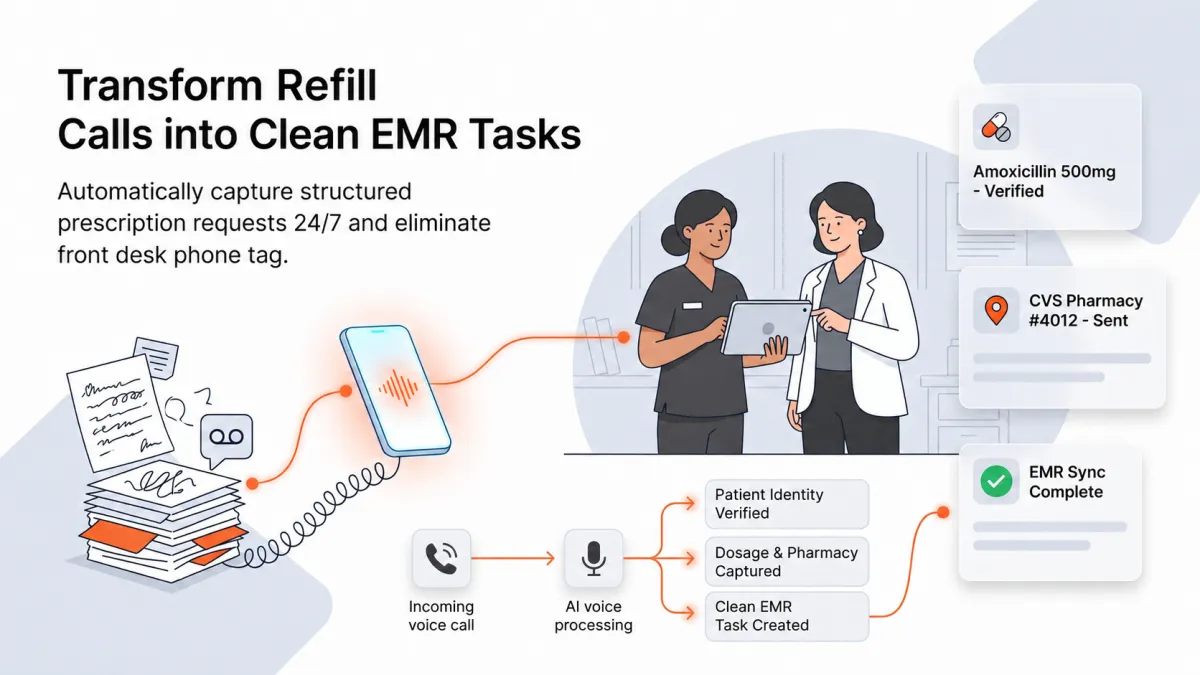
Handling prescription refills manually creates constant phone traffic, delays patient care, and overburdens clinical staff. Traditional intake methods rely on chaotic voicemails and handwritten notes that lack critical details like pharmacy names, exact dosages, or current symptoms. Implementing an AI phone receptionist streamlines this entire workflow by taking intake off the front desk's plate. The AI captures structured, accurate refill details 24/7, verifies necessary patient information, and routes clean requests directly into the practice's electronic medical record (EMR) system for quick clinical approval.
Prescription refill requests are among the most frequent, time-consuming inbound interactions for any medical office. On any given day, an independent medical practice receives dozens of phone calls from patients needing medication renewals, pharmacies seeking authorization, and care team members attempting to verify dosages. While these interactions are essential to ongoing patient care, the traditional method of handling them manually places immense operational strain on clinical and administrative staff.
The process often involves multiple steps, callbacks, and manual data entry. A patient calls, waits on hold, and speaks to a receptionist who manually transcribes details onto a slip of paper or an electronic task list. That message is then routed to a medical assistant or nurse, who must pull the patient's chart, review medication history, check for required lab work, and present the file to a physician for approval. Once approved, someone must contact the pharmacy or transmit the e-prescription, and then call the patient back to confirm the update.
This manual chain of communication creates severe bottlenecks. Front desk staff spend hours managing phone tag, nurses waste valuable time tracking down missing details, and physicians face end-of-day administrative overload. More importantly, delayed refills create frustration for patients and risk gaps in medication adherence.
To maintain high standards of patient care and prevent administrative burnout, independent practices need a more structured approach to managing refill volume. Automating the initial intake and routing of medication requests replaces chaotic phone traffic with clean, structured data, allowing clinical teams to review and authorize renewals in a fraction of the time.
Why Medication Refills Overwhelm Practice Workflows
Medication management is a core component of primary and specialty care. However, the sheer volume of refill requests can quickly derail daily clinic operations when intake relies entirely on live phone calls.
The core challenge stems from the unpredictable nature of phone traffic. Refill calls spike during early morning hours, immediately after lunch, and right before the clinic closes. During these peak intervals, front desk staff must balance checking in arriving patients with answering ringing lines.
When receptionists are rushed, intake quality drops. Important details are easily missed or recorded incorrectly:
Missing or misspelled pharmacy names and store locations.
Incomplete medication names or inaccurate strength and dosage details.
Omission of patient date of birth or updated contact information.
Failure to record whether the patient is experiencing new symptoms or side effects.
When clinical staff receive incomplete messages, they cannot process the request safely. A nurse must take time away from direct patient care to call the patient back, verify the missing details, and leave voicemails, creating a cycle of phone tag that slows down the entire practice.
The Friction of Traditional Refill Intake Methods
To manage phone volume, many practices rely on voicemail boxes dedicated to prescription refills or forward after-hours calls to basic answering services. While these methods remove live calls from the front desk in the moment, they create significant downstream problems.
Voicemail systems are notoriously inefficient for clinical communication. Patients often speak too quickly, omit crucial information, or leave rambling messages that nurses must pause and rewind multiple times to transcribe. Furthermore, callers have no confirmation that their message was received or when it will be reviewed, prompting them to call back several times throughout the day to check on the status.
Traditional live answering services present different limitations. Answering service operators are rarely trained in medical terminology and operate without access to the practice’s systems. They act as message takers rather than functional extensions of the clinical workflow, taking basic notes that still require manual processing by clinic staff later.
Neither approach solves the fundamental issue: converting unstructured, incomplete verbal requests into structured, actionable clinical data.
Restructuring Refill Operations with Voice Automation
Modern voice automation shifts prescription intake from a chaotic phone conversation into an organized, automated intake pipeline. Rather than forcing human staff to act as manual transcribers, conversational AI handles the initial intake step entirely over the phone.
Voice AI platforms engage callers in natural, conversational dialogue. The system understands context, asks appropriate follow-up questions, and ensures every required piece of information is gathered before ending the call.
This approach changes how the practice operates in several key ways:
Calls are answered instantly, eliminating hold times for patients requesting renewals.
Intake occurs 24 hours a day, allowing patients to submit requests when it is convenient for them.
Every request is captured with complete, standardized data fields.
Clinical staff receive clean summaries ready for review rather than unstructured voicemails or scribbled notes.
By automating the intake layer, the practice removes repetitive phone work from receptionists while giving nurses and physicians the structured information they need to process approvals efficiently.
Step-by-Step: How AI Handles a Prescription Refill Call
To understand how voice AI simplifies medication management, it helps to look at the step-by-step workflow during a live patient interaction.
1. Immediate Answer and Identification The AI receptionist answers the call on the first ring, greeting the patient professionally. It identifies that the caller needs a prescription refill and begins the intake process. The system verifies the patient's identity by collecting their full legal name, date of birth, and primary phone number.
2. Gathering Medication Details The AI prompts the patient for the exact name of the medication, dosage, and administration instructions. If the patient is unsure of the exact name, the system asks clarifying questions to narrow down the request accurately.
3. Pharmacy Verification The system confirms where the patient wants the prescription sent. It collects the pharmacy name, street address, cross streets, or phone number to ensure the prescription is routed to the correct location without ambiguity.
4. Clinical Pre-Screening Questions Before finalizing the request, the AI asks practice-defined clinical questions. It checks whether the patient has enough medication remaining to last until the refill is processed, confirms when their last office visit occurred, and asks if they are experiencing any new symptoms or adverse reactions.
5. Structuring and Routing the Request Once all information is gathered, the AI converts the spoken conversation into a structured text summary. This summary is routed directly to the appropriate inbox within the practice's electronic medical record (EMR) system or task management software, creating an actionable task for the clinical team.
6. Setting Patient Expectations The AI concludes the call by informing the patient of the practice's standard processing window—for example, 24 to 48 business hours. This sets clear expectations and significantly reduces duplicate follow-up calls.
The Clinical and Operational Impact of Automated Refills
Streamlining prescription refill intake produces immediate benefits across every level of an independent medical practice.
Faster Processing Times for Patients When clinical staff receive complete, structured requests, processing speed increases dramatically. Nurses can review the chart, verify recent lab work, and route the authorization to the physician in a fraction of the time it takes to parse voicemails. Patients receive their renewals faster, ensuring continuous medication adherence.
Reduced Call Volume at the Front Desk Offloading routine refill calls clears incoming lines for urgent patient inquiries and new appointment scheduling. Front desk staff experience fewer interruptions, allowing them to provide attentive, face-to-face service to patients in the waiting room.
Elimination of Transcribing Errors Spoken medical terms, complex drug names, and specific dosages are easily misheard over poor phone connections. Voice AI uses advanced speech recognition designed for healthcare environments to transcribe details accurately, lowering the risk of clinical error.
Better Workflows for Nurses and Physicians Nurses spend less time playing phone tag and more time delivering direct patient care. Physicians can review batches of pre-screened, organized refill tasks during designated admin time rather than reacting to scattered messages throughout the clinic day.
How Zaya Helps Independent Practices
Zaya provides an AI-powered phone receptionist designed specifically to handle the operational realities of independent medical practices. Built to integrate directly into existing practice workflows, Zaya offloads routine phone traffic from your front desk while providing patients with immediate, reliable service.
Zaya transforms prescription refill management and overall practice communication through a comprehensive set of built-in capabilities:
Answers every call: Keeps phone lines clear by answering 100% of incoming calls on the first ring, day or night, eliminating hold times and missed connections.
Prescription refill requests: Collects complete, structured medication details, pharmacy preferences, and clinical pre-screening answers from callers with high precision.
Schedules appointments: Manages appointment scheduling for new and returning patients according to provider-specific rules and availability.
EMR integration: Connects directly with major electronic medical records platforms to update calendars, cross-reference schedules, and route intake summaries securely.
Appointment changes: Handles cancellations, reschedules, and visit confirmations automatically, keeping provider calendars optimized.
Referral handling: Captures incoming referral information from patients and medical offices, routing documentation directly to the right department.
Multilingual conversations: Communicates fluently in multiple languages, ensuring diverse patient populations can easily request renewals and information.
AI-generated summaries: Creates concise, structured text summaries and transcripts of every call for rapid review by clinical and administrative teams.
After-hours support: Operates continuously outside normal business hours, capturing evening and weekend refill requests so patients never hit a dead end.
By automating routine intake and phone management, Zaya protects your staff from administrative burnout, optimizes daily clinic workflows, and helps your practice deliver prompt, patient-centered care.
Frequently Asked Questions
How does an AI receptionist verify patient and medication details accurately?
The AI guides the caller through a structured conversational workflow. It verifies identity using standard identifiers (full name, date of birth, phone number) and prompts for exact medication names, dosages, and pharmacy locations. Advanced speech recognition built for healthcare ensures complex drug names and medical terms are accurately transcribed into structured data.
How does the AI handle clinical safety and pre-screening during a refill request?
Before completing a request, the AI asks practice-defined pre-screening questions. It checks if the patient has enough medication remaining, confirms the date of their last office visit, and asks if they are experiencing any new symptoms or adverse reactions. This pre-screened summary is then sent directly to the practice's clinical team for safe review.
Will automated prescription refills integrate with our existing EMR software?
Yes. Solutions like Zaya connect directly with major Electronic Medical Record (EMR) systems and task management tools. Instead of leaving voicemails or paper notes, the AI converts spoken calls into concise summaries and routes them straight to the appropriate inbox or chart for fast authorization.
How does voice AI reduce follow-up calls and phone tag for prescription status?
The AI sets clear expectations before ending the call by informing the patient of the practice’s standard processing window (e.g., 24 to 48 hours). Additionally, because calls are answered instantly 24/7 with standardized data collection, requests are processed faster, preventing panicked duplicate calls from patients.
Can an AI receptionist handle other tasks besides prescription refills?
Yes. Platforms like Zaya operate as full-service phone receptionists—answering calls on the first ring, scheduling and updating appointments, managing after-hours inquiries, handling referrals, and communicating fluently in multiple languages.
Optimize Operations by Automating Routine Tasks
A well-run medical practice relies on clear workflows, efficient communication, and an environment where staff can focus on high-quality patient care. When phone lines are congested with routine administrative tasks like prescription refill requests, every aspect of clinic operations suffers—from front desk morale to patient satisfaction.
Modern technology should simplify healthcare administration, not add layers of complexity. By delegating prescription intake and routine call management to intelligent voice automation, independent practices eliminate phone friction while giving clinical teams structured, accurate data to work with.
When nurses and receptionists are freed from the cycle of phone tag and manual transcription, the entire practice operates with greater calm and precision. Patients receive their medications on time, staff members work with less stress, and the office delivers a seamless experience at every point of contact.
Zaya helps independent medical practices modernize their phone operations, protect team bandwidth, and deliver timely care. By ensuring every call is answered instantly and every request is handled accurately, your practice builds a resilient foundation for long-term success.
Talk to Zaya
Experience the difference. Tap the microphone to start a natural conversation with our AI right now.
You'll need to allow microphone access to start the demo.