
How AI Receptionists Boost Google Reviews & Patient Satisfaction
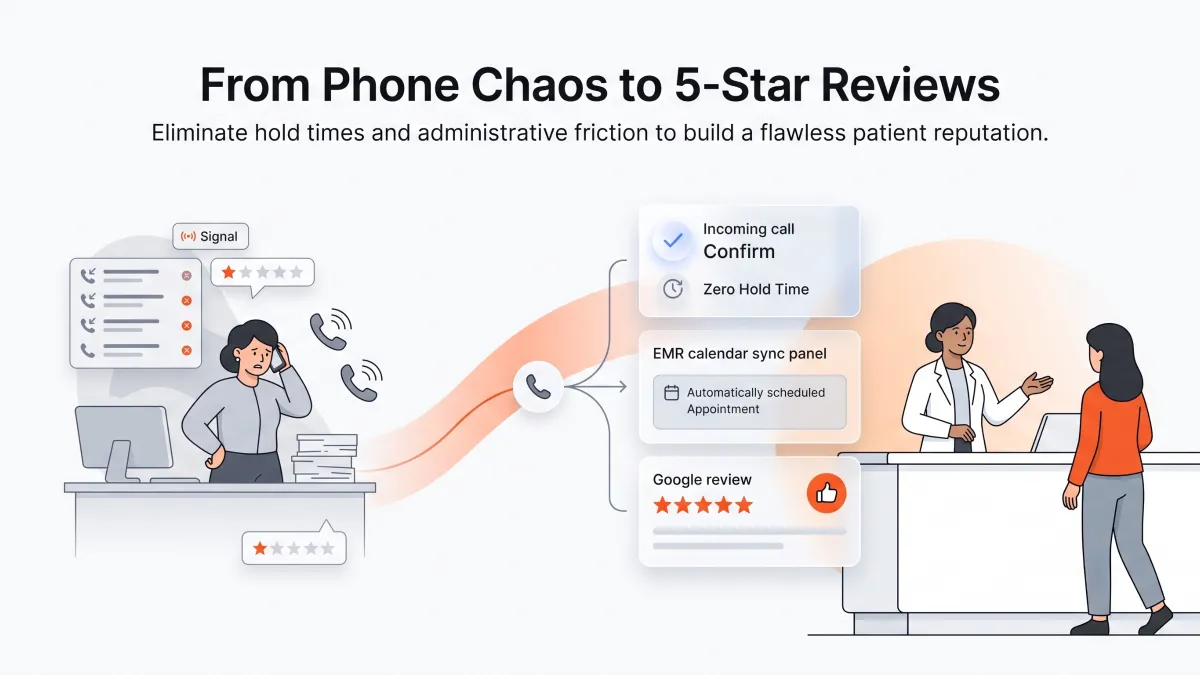
Most negative Google reviews for medical practices stem from administrative friction rather than clinical care. Long hold times, missed calls, and overburdened front desk staff frustrate patients before they ever see a physician. Implementing an AI phone receptionist eliminates hold times, provides 24/7 access for scheduling and routine inquiries, and relieves staff burn out. By creating a frictionless communication experience, independent practices naturally boost patient satisfaction scores and generate a steady stream of positive five-star reviews.
When prospective patients search for a new physician, they rarely start by examining board certifications or hospital affiliations. They start on Google. They look at star ratings, scan recent feedback, and read about how other patients were treated long before they ever set foot in an exam room.
What many practice owners do not realize is that online reviews are seldom a reflection of clinical competence. Patients almost never complain about a physician's diagnostic skill or surgical precision. Instead, negative reviews are almost exclusively driven by administrative friction.
Long hold times, busy signals, unreturned voicemails, and hurried phone interactions create immediate frustration. When a patient feels ignored or disrespected on the phone, that negative emotional experience translates directly into a one-star Google review.
The front desk is the front door of your practice. If the intake experience is chaotic, the perception of your clinical care suffers. Improving your practice’s online reputation requires addressing the root cause of patient dissatisfaction: phone operations.
The Silent Crisis at the Front Desk
For most independent medical practices, the front desk is operating under continuous strain. Staff members are tasked with an overwhelming list of responsibilities that conflict with one another in real time.
A receptionist is simultaneously expected to check in arriving patients, collect copays, verify insurance, manage clinical paperwork, and answer incoming phone calls. When three lines ring at once while a line of patients stands in the waiting room, something has to give.
In most cases, the phone call is what gets sacrificed. Calls are placed on hold for extended periods, routed to voicemail, or dropped entirely.
Patients wait on hold for ten minutes just to ask a simple question.
Staff members feel rushed, leading to clipped or tense conversations.
Inbound calls during peak hours frequently go unanswered.
Voicemails accumulate throughout the day, creating an insurmountable backlog.
This creates a high-friction environment for both staff and patients. Staff members suffer from chronic burnout and high turnover, while patients feel undervalued and neglected.
Why Patient First Impressions Dictate Practice Growth
Patient perception begins the moment a person attempts to contact your practice. In modern healthcare, access is synonymous with quality. If a practice is difficult to reach, patients assume the care will be equally difficult to navigate.
The relationship between phone experience and online reputation is direct. When a patient encounters operational friction, their emotional reaction dictates their review behavior.
Unanswered calls communicate a lack of care and professionalism.
Long hold times make patients feel that their time is not valued.
Tense interactions with overwhelmed staff set an adversarial tone.
Inability to schedule after hours forces patients to seek care elsewhere.
Online reviews carry immense weight in healthcare decision-making. A vast majority of prospective patients evaluate online ratings before choosing a primary care doctor or specialist.
A single negative review detailing poor customer service can deter dozens of potential new patients. Conversely, a practice with hundreds of five-star reviews highlighting prompt, helpful service gains a distinct competitive advantage in its local market.
The Operational Bottlenecks Ruining Patient Experience
To understand why traditional front desk workflows fail patient satisfaction metrics, it helps to examine the structural bottlenecks inherent in phone operations.
High Call Volume Velocity Call volume in medical practices is not evenly distributed throughout the day. Calls spike dramatically first thing in the morning, right after lunch, and near the end of the day. Human staff cannot scale instantly to handle thirty incoming calls during a 9:00 AM rush.
Repeated Routine Inquiries A significant percentage of incoming calls are repetitive, low-complexity questions. Patients routinely call to confirm appointment times, ask for office directions, request billing clarification, or ask about accepted insurance plans. These routine calls consume hours of staff time that could be spent on high-touch patient care.
After-Hours Communication Deficits Health concerns and scheduling needs do not stop at 5:00 PM. Working adults often attempt to manage their healthcare schedules during evenings and weekends. Traditional answering services are often expensive, slow, and unable to perform basic tasks like scheduling or updating records.
Multitasking Breakdown Human beings cannot deliver empathetic, high-quality phone service while simultaneously processing complex clinical documentation and speaking to an in-person patient. Multitasking dilutes focus, increases errors, and creates an impersonal experience for the caller.
Rethinking Patient Communication with Modern Automation
Solving front desk operational challenges requires moving away from the assumption that every phone call must be answered by a human staff member.
Modern healthcare technology allows practices to automate routine incoming calls without sacrificing conversational quality or warmth. Conversational AI technology has evolved beyond rigid interactive voice response systems that force callers to press buttons.
Practices can now deploy intelligent voice systems that engage callers in natural, human-like dialogue.
Calls are answered instantly on the first ring, regardless of call volume.
Routine tasks like scheduling, rescheduling, and cancellation are handled end-to-end.
Callers communicate naturally using regular speech rather than keypads.
Staff members are freed from high-volume routine calls to focus on clinical support.
By shifting routine inbound communication to intelligent automation, independent practices eliminate phone wait times entirely while giving staff the mental bandwidth to deliver exceptional in-person service.
The Tangible Benefits of Seamless Patient Access
When a medical practice eliminates phone access barriers, the operational and financial improvements are immediate and measurable.
Elimination of Abandoned Calls When calls are answered immediately, call abandonment drops to zero. Patients get their answers right away instead of hanging up in frustration.
Increased Appointment Capture Rate A substantial portion of prospective patient calls are lost when callers reach voicemail or are placed on hold. Immediate answer rates ensure every prospective patient is captured and scheduled.
Improved Front Desk Staff Retention Removing repetitive, stressful call spikes lowers workplace anxiety for front office personnel. When staff members are not constantly interrupted by ringing phones, job satisfaction increases and turnover decreases.
Higher Review Velocity and Ratings Satisfied patients are far more likely to leave positive reviews. When access is effortless, the primary driver of negative online feedback disappears, causing overall star ratings to rise naturally.
How AI Phone Receptionists Elevate Patient Satisfaction
An AI phone receptionist acts as an extension of your front office, handling inbound communication with consistency, patience, and accuracy.
Unlike traditional answering services or static phone trees, an AI system understands context, processes complex requests, and interacts with empathy.
Zero Hold Times The AI answers every call on the first ring. Whether one patient calls or fifty patients call simultaneously, each caller receives immediate, dedicated attention.
24/7/365 Availability Patients can schedule, reschedule, or inquire about practice policies at 10:00 PM on a Sunday just as easily as at 10:00 AM on a Tuesday.
Consistent, Empathetic Tone An AI receptionist never experiences fatigue, stress, or bad days. Every caller receives the same polite, professional, and clear assistance regardless of peak call hours.
Reduction of In-Person Friction With phone lines handled automatically, in-person staff can give undivided attention to patients arriving at the clinic. Waiting room check-ins become faster, warmer, and more personal.
When patients experience fast, effortless service at every touchpoint, their overall perception of the practice transforms. This positive experience directly translates into organic, five-star Google reviews praising the office's efficiency and care.
How Zaya Helps Independent Medical Practices
Zaya provides an AI-powered phone receptionist designed specifically for independent medical practices. Built to integrate directly into existing practice workflows, Zaya removes administrative burden from your front desk while providing patients with immediate, high-quality assistance.
Zaya delivers comprehensive capabilities tailored to clinical phone management:
Answers every call: Eliminates hold times and missed calls by answering every inbound line instantly, day or night.
Schedules appointments: Manages appointment scheduling for new and returning patients according to provider-specific rules and availability.
EMR integration: Connects directly with major electronic medical records systems to view calendars and update patient information in real time.
Appointment changes: Handles rescheduling and cancellation requests smoothly without staff intervention.
Prescription refill requests: Collects structured refill details from patients and routes accurate requests directly to clinical staff.
Referral handling: Collects inbound referral information and routes documents to the appropriate department.
Multilingual conversations: Communicates fluently in multiple languages, ensuring clear access for diverse patient populations.
AI-generated summaries: Provides staff with concise, written call summaries and transcripts for quick review.
After-hours support: Delivers full operational capabilities outside standard business hours, ensuring your practice is always open to patient needs.
By serving as a reliable partner to your front office team, Zaya ensures no patient call goes unanswered, protecting your staff from burnout and protecting your practice's reputation.
Frequently Asked Questions
Why do administrative phone issues have a bigger impact on Google reviews than clinical care?
Patients expect high-quality clinical care as a standard baseline, but they evaluate their overall experience based on accessibility and customer service. Long hold times, unanswered calls, and rushed phone interactions create immediate frustration that patients express online, making administrative friction the leading driver of negative reviews.
How does an AI receptionist directly improve a practice's star rating?
An AI receptionist removes the primary sources of patient complaints by offering zero hold times, immediate answers, and 24/7 scheduling. By turning a historically stressful intake process into an effortless interaction, patients are far more inclined to leave positive five-star feedback on Google.
Will patients feel frustrated talking to an AI instead of a human when leaving feedback or scheduling?
Modern AI receptionists engage callers in natural, conversational speech rather than rigid, button-pressing phone menus. Patients appreciate the immediate assistance and lack of hold time, which creates a smooth experience that leaves them feeling valued and heard.
How does automating call management protect front desk staff from negative interactions?
When AI handles high-volume call spikes and routine requests, front office staff are no longer forced to multitask between ringing phones and in-person patients. This reduces daily chaos, prevents staff burnout, and allows team members to deliver calm, attentive service to patients in the waiting room.
Can AI help independent practices generate more Google reviews automatically?
By capturing every inbound call—including after-hours inquiries—and delivering consistent, prompt service, AI ensures every patient touchpoint is positive. This elevated level of operational reliability naturally increases overall patient satisfaction, providing a strong foundation for organic five-star reviews.
Grow by Converting More of What You Already Have
Building a thriving medical practice requires balancing exceptional clinical care with seamless operational efficiency. When phone lines are congested and staff members are overwhelmed, patient satisfaction drops, and online reviews reflect that strain.
Technology should not diminish the human element in healthcare; it should protect it. By offloading routine call management and scheduling to automated systems, practices restore calm to the front desk.
When your front office staff has the breathing room to greet in-person patients with warmth and focus, the entire atmosphere of your clinic improves. Patients notice the difference, and that appreciation naturally spreads to your public online reputation.
Zaya helps independent practices protect their staff, streamline patient communication, and build a reputation for effortless care. When every call is answered promptly, your practice grows organically through the power of satisfied patients.
Talk to Zaya
Experience the difference. Tap the microphone to start a natural conversation with our AI right now.
You'll need to allow microphone access to start the demo.