
How AI Receptionists Reduce Front Desk Burnout & Help Staff
Front desk teams are juggling more responsibilities than ever. Learn how AI receptionists reduce repetitive administrative work, minimize interruptions, and improve staff satisfaction while allowing your team to focus on delivering exceptional patient care.
Every medical practice depends on its front desk.
They're often the first person patients speak to, the first face they see when they arrive, and the team responsible for keeping the entire office running smoothly.
But today's front desk staff are being asked to do more than ever before.
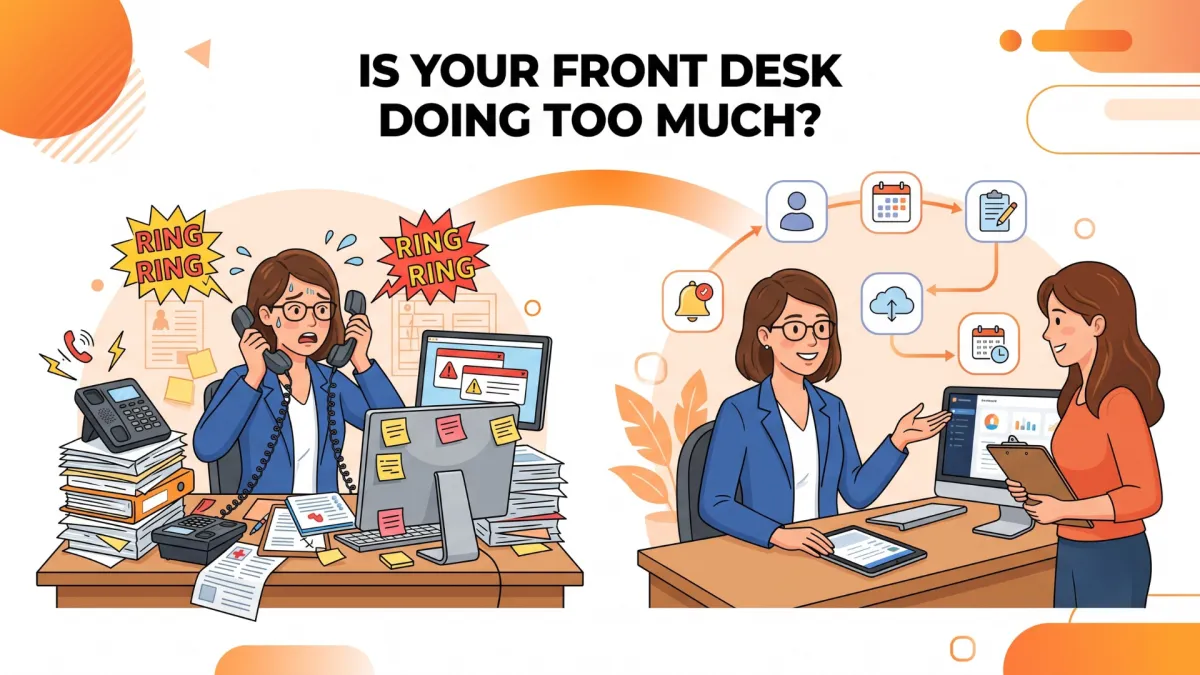
They're answering phones, checking in patients, verifying insurance, collecting payments, processing referrals, handling prescription refill requests, managing provider schedules, responding to portal messages, and helping patients in person, often all at the same time.
It's no surprise that burnout has become one of the biggest challenges facing medical practices today.
The good news is that solving burnout doesn't always require hiring more staff.
Sometimes, it means giving your existing team the right tools to succeed.
The Modern Front Desk Has Become a Command Center
Healthcare has changed dramatically over the past decade.
Administrative responsibilities continue to grow while patient expectations continue to rise.
Receptionists are expected to manage multiple communication channels simultaneously, including:
Incoming phone calls
Walk-in patients
Patient portal messages
Insurance verification
Referrals
Prescription refill requests
Billing questions
Appointment scheduling
Provider communication
Each interruption forces staff to stop what they're doing and shift their attention elsewhere.
Over time, this constant multitasking becomes exhausting.
What Burnout Looks Like
Burnout isn't simply feeling busy.
It develops gradually as employees experience ongoing stress without enough time to recover.
Common signs include:
Feeling overwhelmed throughout the day
Difficulty concentrating
Increased mistakes
Emotional exhaustion
Frustration with repetitive tasks
Lower job satisfaction
Higher turnover
Medical practices often notice these issues long before employees actually resign.
Reducing unnecessary administrative work can make a meaningful difference in staff morale.
Why Phone Calls Create So Much Stress
Phone calls are unpredictable.
Unlike scheduled appointments, they demand immediate attention.
Imagine this scenario.
A receptionist is:
Helping a patient check in.
Collecting a copay.
Answering a physician's question.
Meanwhile:
The phone rings.
A pharmacy calls.
Another patient walks through the door.
A lab needs clarification.
Two more calls arrive.
Even experienced staff can only do one thing at a time.
Eventually, someone has to wait.
Unfortunately, constant interruptions make it difficult to complete any task efficiently.
Repetitive Calls Consume Valuable Time
Many incoming calls involve the same conversations repeated dozens of times every day.
Examples include:
"I'd like to schedule an appointment."
"What time do you close?"
"Do you accept my insurance?"
"Can I refill my prescription?"
"Has my referral been received?"
"Where are you located?"
These questions are important.
But they don't always require a staff member to answer personally.
Hiring More Receptionists Isn't Always the Answer
When phone volume increases, many practices immediately think about hiring another receptionist.
Unfortunately, that's becoming increasingly difficult.
Healthcare organizations continue facing:
Staffing shortages
Rising labor costs
Lengthy hiring processes
Ongoing training requirements
Employee turnover
Even after hiring additional staff, call volume often continues growing.
Adding more people doesn't always solve the underlying workflow problem.
Technology Can Reduce Administrative Burden
Healthcare technology has transformed many clinical workflows.
Electronic medical records replaced paper charts.
Online patient portals reduced paperwork.
Digital prescribing simplified medication management.
Now, AI is improving patient communication.
Rather than replacing employees, AI handles repetitive conversations that consume valuable time throughout the day.
This allows staff to focus on work requiring empathy, judgment, and personal interaction.
How AI Receptionists Support Front Desk Teams
An AI receptionist functions like an additional member of your administrative team.
It answers calls immediately and helps patients complete routine requests without placing additional demands on your staff.
Depending on your practice's workflow, an AI receptionist can:
Schedule appointments
Reschedule existing visits
Answer office questions
Collect prescription refill requests
Route calls appropriately
Gather patient information
Generate call summaries
Support multiple languages
Instead of returning dozens of voicemail messages each morning, your team starts the day with organized information and completed tasks.
AI Doesn't Replace Human Connection
One of the biggest concerns practices have is whether AI will replace their front desk employees.
The answer is no.
Healthcare depends on relationships.
Patients still want compassionate people available when situations become complex or emotional.
AI simply removes repetitive conversations that don't require human judgment.
Think of it this way.
Your receptionist spends less time answering the same scheduling questions and more time helping the patient standing in front of them.
The technology supports people.
It doesn't replace them.
Better Experiences for Patients
Reducing front desk workload also improves the patient experience.
Patients benefit from:
Shorter hold times
Immediate answers
Faster appointment scheduling
Less voicemail
Better communication
More consistent service
Patients don't necessarily care whether they're speaking with AI.
They care whether their problem gets solved quickly.
When it does, satisfaction improves.
Better Experiences for Staff
Employees benefit too.
Instead of constantly switching between phone calls and in-person patients, they can:
Complete tasks without interruption
Spend more time helping patients face-to-face
Reduce workplace stress
Improve accuracy
Feel more productive
End the day with fewer unfinished tasks
Supporting your team often leads to better retention and higher job satisfaction.
Signs Your Front Desk Is Experiencing Burnout
Your practice may benefit from workflow automation if:
Receptionists rarely have time to finish administrative work.
Patients frequently reach voicemail.
Staff constantly apologize for hold times.
Employees report feeling overwhelmed.
Appointment scheduling consumes several hours each day.
The phone rings continuously throughout the day.
Turnover has become more frequent.
These aren't signs of poor employees.
They're signs of overloaded systems.
How Zaya Helps Medical Practices
Zaya was built specifically for healthcare practices.
Instead of replacing your front desk, Zaya works alongside your existing team to improve patient communication and reduce administrative workload.
With Zaya, your practice can:
Answer every incoming call 24/7
Schedule appointments directly into supported EMRs
Handle routine patient questions
Collect prescription refill requests
Route urgent calls based on your workflow
Generate AI-powered call summaries
Support multilingual conversations
Ensure patients always reach someone, even after hours
By reducing repetitive phone conversations, Zaya allows your staff to focus on delivering exceptional patient care while improving operational efficiency.
Frequently Asked Questions
Will AI replace my receptionist?
No. Zaya is designed to support your front desk by handling repetitive conversations while allowing staff to focus on patients and more complex administrative tasks.
Can AI answer every phone call?
Yes. Zaya answers calls 24 hours a day, including evenings, weekends, and holidays.
Does AI understand medical office workflows?
Yes. Zaya can be customized to match your practice's providers, scheduling rules, office policies, and patient communication workflows.
Can AI schedule appointments?
Yes. Zaya can schedule appointments directly into supported electronic medical record systems while following your practice's scheduling rules.
Is AI difficult for staff to learn?
No. Zaya works in the background, allowing your existing workflows to continue with minimal disruption.
Final Thoughts
Your front desk team is one of the most valuable parts of your practice.
They shouldn't spend every day racing to answer ringing phones while juggling countless other responsibilities.
Burnout isn't caused by employees who don't work hard enough.
It's caused by systems that expect too much from too few people.
By automating repetitive conversations, improving patient access, and reducing interruptions, practices can create a better experience for both patients and staff.
The goal isn't replacing your receptionists.
It's giving them the support they need to provide exceptional service every day.
That's exactly what Zaya was built to do.
Talk to Zaya
Experience the difference. Tap the microphone to start a natural conversation with our AI right now.
You'll need to allow microphone access to start the demo.