
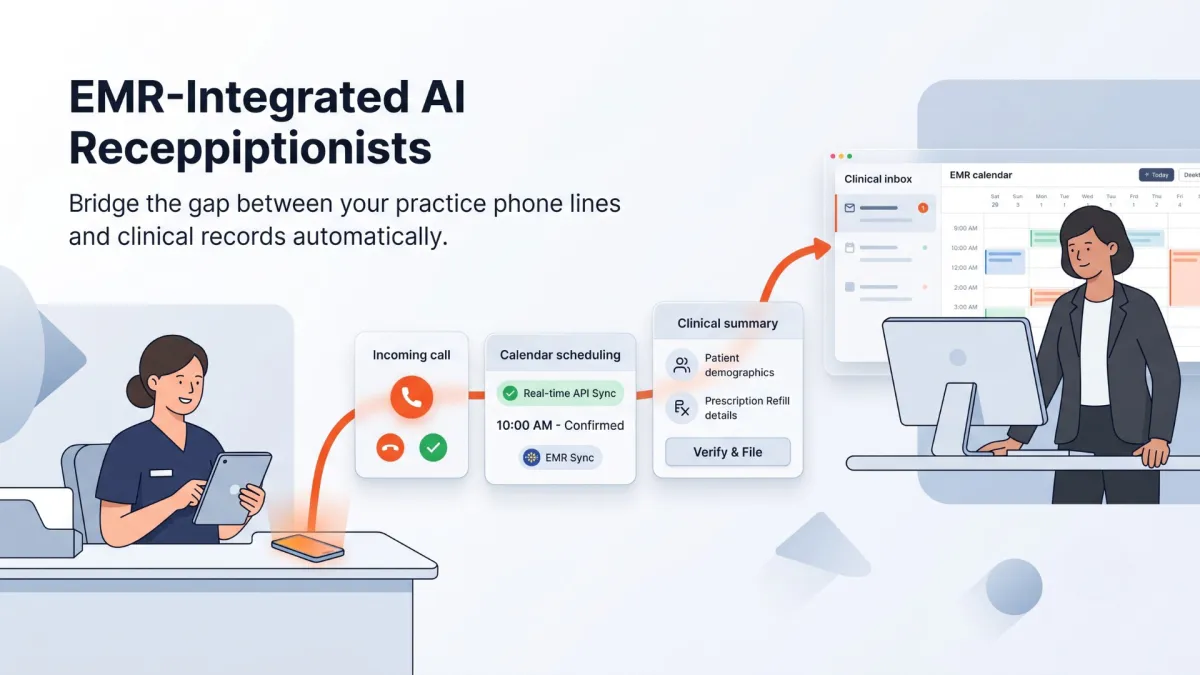
Bridge Phone Calls and EMRs with an AI Medical Receptionist
An EMR-integrated AI receptionist connects inbound phone calls directly to your practice management software, allowing artificial intelligence to answer calls instantly, check live provider schedules, book appointments, and capture clinical intake details 24/7. Unlike standalone call services or traditional phone trees, an integrated solution reads real-time calendar availability, writes confirmed bookings directly to your EMR, and generates structured clinical summaries for staff review. This automation removes manual data re-entry from your front desk, lowers call abandonment, prevents lost referral revenue, and ensures full HIPAA compliance without disrupting existing clinical workflows.
For independent medical practices, the front desk is the center of patient access, administrative coordination, and clinical workflow initialization. Every day, front office staff manage hundreds of inbound phone calls ranging from new patient inquiries and appointment scheduling to prescription refill requests and referral transfers.
However, a structural disconnect exists in most medical offices: the system that handles phone calls operates completely separate from the system that manages clinical records. The phone rings on one desk, while the Electronic Medical Record (EMR) system sits on a separate monitor.
When phone communication and EMR data live in separate silos, front desk personnel spend hours manually translating verbal phone conversations into digital chart notes, appointment slots, and intake forms. This manual double-entry creates operational friction, increases data entry errors, extends hold times, and leads to severe administrative burnout.
Integrating voice artificial intelligence directly with your practice management and EMR system bridges this operational gap. By connecting phone conversations to live clinical data in real time, practices eliminate phone bottlenecks, protect data accuracy, and give patients seamless access to care.
The Hidden Fragmentations of Unintegrated Front Office Phone Systems
In a traditional medical office setup, inbound communication and electronic record-keeping operate on parallel tracks that rarely intersect automatically. When a patient calls, the receptionist must pause, locate the patient’s record in the EMR, verify personal details, toggle to the calendar module, find an open time slot, and manually type in the appointment parameters while keeping the patient on the line.
This fragmented workflow creates significant operational Drag across the practice. Call handle times stretch from ninety seconds to five or six minutes per interaction. During morning and afternoon surges, phone lines quickly back up, leading to dropped calls, long hold times, and missed patient opportunities.
The disconnect also creates data fidelity risks. When staff members are forced to rush through phone calls while managing in-person check-ins, critical clinical details are often lost or miskeyed.
Subscriber names and insurance group numbers are transcribed with typographical errors.
Appointment visit types are assigned incorrectly, leading to calendar double-bookings or inadequate exam time.
Patient symptom descriptions recorded on paper notes fail to reach the clinical chart before the appointment.
Voicemails left after hours sit unread until late the following morning, delaying patient care.
The fundamental issue is not staff incompetence; it is system fragmentation. Expecting human receptionists to serve as manual data bridges between an analog phone system and a digital EMR creates an operational bottleneck that scales poorly as a practice grows.
Why Standalone Phone Solutions Create Operational Bottlenecks
To manage heavy call volumes, many practice managers attempt to deploy standalone communication tools. These typically include outsourced call centers, traditional answering services, or basic auto-attendant phone trees. While these tools answer incoming lines, they frequently introduce new operational problems because they operate outside the practice's core EMR software.
Third-party answering services employ operators who lack access to your live schedule and clinical protocols. As a result, they can only take basic messages or write notes on external web portals.
This approach creates a secondary workflow burden for your internal staff:
Double Data Entry: Front desk staff must read external message logs or email summaries and manually copy that information into the EMR chart.
The Phone Tag Cycle: Because third-party operators cannot book directly into provider calendars, patients still require a manual callback from clinic staff to confirm an appointment time.
Out-of-Sync Schedules: External call centers operating on static, exported calendar spreadsheets frequently book appointments into time slots that have already been filled internally.
Lack of Clinical Context: Non-medical answering service staff cannot distinguish between routine scheduling requests and time-sensitive clinical symptoms, creating potential triage hazards.
Relying on external message-takers simply defers administrative work rather than eliminating it. To solve phone bottlenecks permanently, the intake tool must possess real-time reading and writing capabilities inside your primary practice management platform.
How EMR Integration Works: Real-Time Sync vs. Asynchronous Summaries
An EMR-integrated AI receptionist combines conversational voice software with secure application programming interfaces (APIs) to interact with your practice management system. Understanding how data moves between the voice AI and your EMR helps practice leaders evaluate system capabilities and security protocols.
Modern healthcare voice integration relies on two primary data interaction models: direct synchronous write-back and structured asynchronous summaries.
Direct Synchronous Write-Back When an AI receptionist engages with a caller, it queries your EMR's scheduling calendar via real-time API calls. The system reads live provider availability, applies specific booking rules—such as buffering time between procedures or limiting specific visit types to designated days—and presents available slots to the caller. Once the caller selects a time, the AI writes the appointment directly to the EMR calendar within seconds, locking the slot across all practice workstations simultaneously.
Structured Asynchronous Intake Summaries While calendar appointments are written directly, complex clinical information—such as chief complaints, medical histories, or symptom descriptions—requires a different protocol. To maintain clinical oversight and compliance, voice AI captures patient statements, transcribes the conversation, formats the data into structured clinical text, and delivers it to an EMR task inbox or chart holding area. Staff members can then review, verify, and file the note into the official record with a single click.
By combining immediate calendar write-back with structured administrative summaries, an integrated AI handles routine transaction tasks automatically while keeping licensed clinical personnel in complete control of patient chart records.
Core Workflows Transformed by EMR-Integrated Voice AI
Connecting voice artificial intelligence directly to your EMR transforms routine daily interactions across administrative, clinical, and billing departments.
New Patient Onboarding and Demographic Capture When a new patient calls, the AI collects demographic details—including full legal name, date of birth, contact information, and residential address—using clear, natural conversational dialogue. The AI formats these data points and creates a new patient shell or record within your EMR system automatically, eliminating manual typing for your front office team.
Complex Calendar Scheduling and Rule Enforcement Specialty practices often operate under complex booking guidelines. For example, a sports medicine specialist may require thirty minutes for a new injury consultation but only fifteen minutes for a post-injection follow-up. An EMR-integrated AI receptionist reads provider-specific visit type configurations directly from the EMR, enforcing custom scheduling logic automatically on every call.
Self-Service Appointment Changes and Cancellations When patients call to reschedule or cancel an existing visit, the AI verifies their identity against EMR records, retrieves their scheduled slot, removes or moves the appointment, and instantly frees up the open calendar slot for another patient. This real-time calendar update prevents open gaps in provider schedules.
Structured Prescription Refill Collection Handling medication renewals manually requires extensive staff time. An integrated AI receptionist captures exact drug names, dosages, pharmacy locations, and patient symptom status over the phone. The details are parsed into standardized clinical text and sent straight to the EMR prescription inbox for physician sign-off.
Streamlined Inbound Referral Inquiries Referrals from primary care doctors or urgent care clinics carry high intent but are easily lost if the patient hits voicemail. Voice AI identifies referral callers, gathers the referring physician's details and diagnosis codes, captures patient insurance information, and creates a referral tracking task inside the EMR for immediate intake processing.
Measuring the Operational and Financial ROI of EMR Integration
Investing in integrated front office technology yields measurable returns across clinical throughput, staff labor efficiency, and patient acquisition metrics.
Elimination of Administrative Data Entry Costs Manual phone intake requires substantial staff time. By automating routine demographic capture, appointment creation, and cancellation handling, practices reduce front office administrative workload by several hours per employee each day. Staff members can redirect their focus toward patient care, rooming, billing authorizations, and complex patient navigation.
Maximizing Provider Schedule Utilization Unfilled provider slots represent unrecoverable revenue. Because EMR-integrated AI operates 24 hours a day, 7 days a week, patients can book, reschedule, or fill open schedule gaps at any time—including evenings and weekends. Continuous calendar access keeps provider schedules operating at full capacity.
Reduction in Call Abandonment and Patient Leakage When patients encounter long hold times or busy signals, a significant percentage disconnect and contact a competing practice. Immediate call answering ensures that 100% of inbound calls are captured, protecting your marketing investment and preserving patient lifetime value.
Decreased Front Office Turnover Front desk personnel face high rates of burnout driven by constant noise, phone interruptions, and multitasking friction. Removing repetitive phone duties stabilizes the workplace environment, improves employee job satisfaction, and significantly lowers hiring and retention costs.
Technical and HIPAA Security Standards for Healthcare AI
Deploying artificial intelligence within a healthcare setting requires adherence to strict privacy, security, and data governance standards. Practice leaders must ensure that any voice AI platform meets regulatory compliance requirements before connecting it to an EMR system.
Business Associate Agreements (BAAs) Any AI technology partner handling Protected Health Information (PHI) must sign a formal Business Associate Agreement. This legally binding document ensures the vendor assumes liability for safeguarding patient data in accordance with federal standards.
Encryption in Transit and at Rest All audio streams, call transcripts, and data transmissions passing between the voice AI platform and your EMR system must utilize advanced encryption protocols. Standard security expectations include TLS 1.2 or higher for data in transit and AES-256 bit encryption for data stored at rest.
Data Privacy and Model Isolation Healthcare AI systems must protect patient privacy by isolating practice data. Patient phone calls, clinical summaries, and demographic records should never be used to train public machine learning models or shared across external tenant boundaries.
Audit Trail Logging and Access Controls An enterprise-grade AI integration logs every API interaction, calendar booking, and record lookup with precise timestamps. These detailed audit logs ensure full transparency for practice compliance officers and simplify regulatory reporting.
Turning EMR Integration into Real Workflow Improvement
Disconnected phone systems and EMRs force front office teams to become the manual link between patient conversations and clinical records. Every appointment booked, demographic update, prescription request, or referral often requires duplicate data entry, increasing administrative workload and creating opportunities for costly errors.
Zaya addresses this challenge by integrating its AI receptionist directly with your EMR and practice management software. Instead of simply answering calls or taking messages, Zaya enables patient conversations to become actionable workflows within your existing systems.
With real-time EMR integration, Zaya can:
Read live provider schedules before offering appointment availability.
Book, reschedule, and cancel appointments directly within your EMR calendar.
Capture patient information and synchronize it with existing records.
Route structured prescription refill requests and referral information into the appropriate clinical workflows.
Generate organized call summaries that provide staff with accurate context for follow-up while maintaining clinical oversight.
By eliminating the disconnect between phone communications and electronic medical records, Zaya reduces manual administrative work, improves scheduling accuracy, minimizes data entry errors, and helps independent practices operate more efficiently while delivering a better patient experience.
Frequently Asked Questions
Won't replacing front desk staff with AI harm patient relationships?
No. Voice AI is designed to augment front desk teams, not eliminate them. By taking over high-volume, repetitive phone calls—like basic scheduling, prescription refills, and after-hours inquiries—it eliminates phone-ring interruptions. This allows your in-office staff to dedicate their full attention to delivering warm, personalized care to the patients physically sitting in front of them.
How does voice AI handle complex practice scheduling rules without double-booking?
Unlike third-party call centers that rely on static, exported spreadsheets, an EMR-integrated voice AI connects directly to your live calendar via real-time APIs. It reads live provider availability and automatically enforces your practice’s unique booking logic—such as procedure buffer times, visit-type duration limits, and provider-specific availability—writing confirmed slots directly into your EMR in seconds.
Is patient health data safe when using an AI phone receptionist?
Yes. Modern healthcare AI platforms adhere to strict HIPAA and security standards. Data transmission between the voice AI and your EMR uses TLS 1.2+ encryption in transit and AES-256 bit encryption at rest. Additionally, vendors sign a formal Business Associate Agreement (BAA), maintain detailed audit logs, and ensure your practice's data is never used to train public machine learning models.
What happens with complex clinical information like symptom descriptions or medical histories?
To maintain clinical safety and compliance, voice AI uses structured asynchronous intake summaries for non-transactional clinical details. Instead of writing directly into permanent record fields, it transcribes, formats, and routes notes directly to an EMR task inbox. Clinical staff can review, verify, and attach these notes to the official patient chart with a single click.
How does voice AI compare to traditional third-party answering services?
Traditional answering services operate completely outside your EMR, leading to phone tag, out-of-sync calendar bookings, and manual double-data entry for your staff. Voice AI operates directly inside your primary practice management platform, reading and writing data in real time to resolve caller needs immediately without deferring work back to your internal team.
Which EMR and practice management platforms can Zaya connect with?
Zaya integrates via secure APIs with major EMR and practice management platforms across various specialties—including Epic, athenahealth, eClinicalWorks, NextGen, Tebra, AdvancedMD, Elation, ModMed, and DrChrono
.Bridging the Gap Between Phone Lines and Clinical Records
Sustainable growth for independent medical practices depends on protecting patient access while eliminating administrative friction. When phone systems and EMRs operate in isolated silos, front desk personnel are forced to act as manual data bridges—a dynamic that inevitably leads to long hold times, data entry errors, and severe staff burnout.
Deploying an EMR-integrated voice AI transforms inbound phone traffic from a chaotic operational bottleneck into a streamlined, automated workflow. By enabling real-time calendar write-backs, automated demographic capture, and structured clinical summaries, practices keep provider schedules full and data accurate around the clock.
Ultimately, technology should work quietly in the background to simplify care delivery. By letting intelligent automation manage the phones, your front office team gains the space and bandwidth needed to deliver exceptional, uninterrupted care to every patient in your clinic.
With Zaya, independent practices can eliminate data entry drag, protect staff bandwidth, and deliver a seamless, modern patient experience from the very first call.
Talk to Zaya
Experience the difference. Tap the microphone to start a natural conversation with our AI right now.
You'll need to allow microphone access to start the demo.