
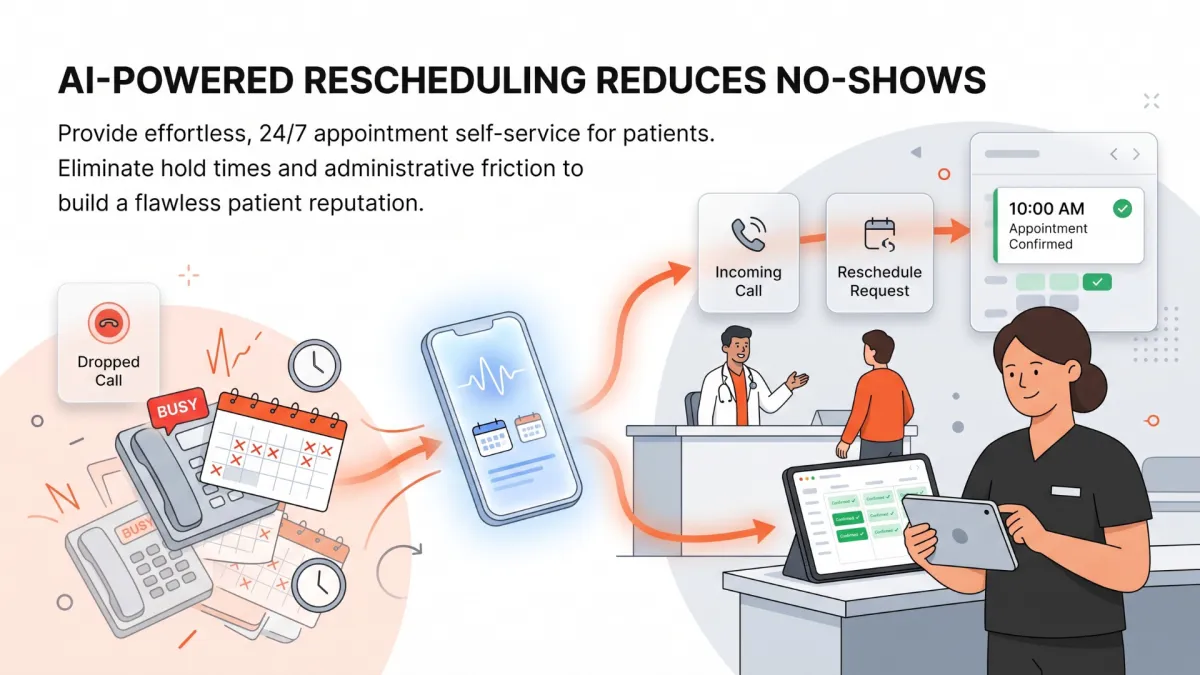
Reduce Appointment No-Shows with an AI Receptionist
Appointment no-shows in independent medical practices are primarily driven by administrative friction, extended phone hold times, and rigid business-hour communication channels. When rescheduling or cancelling a visit requires an arduous phone call, patients frequently default to skipping their appointments entirely. Implementing an AI phone receptionist eliminates these barriers by delivering automated, interactive appointment reminders, providing immediate 24/7 self-service rescheduling, sending precise pre-visit preparation instructions, and updating EMR calendars in real time. This seamless communication infrastructure significantly reduces no-show rates, recovers open calendar slots, and stabilizes practice revenue.
Every empty slot on a provider's daily calendar represents a breakdown in clinical care and practice revenue. When a patient fails to show up for an appointment, the impact ripples across the entire medical office. The physician loses dedicated time that could have been spent treating someone else, waiting lists grow longer, and the administrative cost of trying to reschedule or follow up mounts continuously.
For independent medical practices, appointment no-shows are rarely caused by patient apathy. Most often, they stem from administrative friction and communication gaps. Patients forget their appointments, encounter unexpected work or personal conflicts, lose their pre-appointment preparation instructions, or find it too difficult to reach the office during business hours to cancel or reschedule.
When cancelling or rescheduling requires waiting on hold for ten minutes during a busy workday, patients simply give up and skip the visit. Modernizing practice operations requires recognizing that no-shows are primarily an access and communication problem. Solving it requires giving patients effortless, two-way communication channels that operate around the clock.
The True Financial and Clinical Impact of No-Shows
In a busy independent practice, open calendar gaps directly undermine sustainability. While a single missed appointment might seem minor, the cumulative effect over weeks and months creates substantial financial drag and operational inefficiency.
The financial damage of a missed visit extends far beyond the lost co-pay or initial consultation fee:
Unrecoverable provider time that cannot be reallocated on short notice.
Wasted administrative overhead spent preparing charts, verifying insurance, and setting up rooms.
Reduced downstream revenue from unbilled diagnostic tests, follow-up treatments, or procedural care.
Distorted schedule density that forces practices to overbook, increasing wait times for on-time patients.
Beyond the balance sheet, no-shows actively harm patient health outcomes. Chronic conditions go unmonitored, preventive screenings are delayed, and acute symptoms escalate into emergency room visits.
When a patient misses a routine follow-up, their care plan is interrupted. Re-engaging that patient requires staff time that could be better spent on direct clinical support.
Why Patients Miss Appointments
Understanding why patients fail to keep their appointments is essential to building an effective prevention strategy. While emergencies do occur, the vast majority of no-shows are linked to predictable operational breakdowns.
Communication Friction The traditional process for changing an appointment is frustrating. If a patient realizes on Sunday evening or during a busy workday that they cannot make a 9:00 AM Tuesday visit, reaching the clinic requires calling during standard operating hours. Facing long hold times or busy signals, the patient gives up, intending to call back later, and eventually forgets.
Lapses in Memory Healthcare is rarely top-of-mind for busy adults. When appointments are booked weeks or months in advance, patients naturally lose track of dates and times if they do not receive timely, interactive reminders.
Confusion Over Pre-Visit Instructions Certain clinical procedures require specific preparation, such as fasting, stopping specific medications, or completing lab work beforehand. If a patient is uncertain about these instructions or fails to complete them, they often skip the appointment out of anxiety or embarrassment rather than calling to clarify.
Lack of Transportation or Scheduling Conflicts Work obligations, childcare issues, and transportation delays frequently arise on short notice. If a practice lacks an immediate, simple mechanism for patients to adjust their appointment time, the patient has no option but to miss the visit.
Structural Friction in Traditional Reminder Systems
Medical practices have long recognized the need for appointment reminders. However, traditional methods—such as manual staff phone calls, basic text blasts, and mailers—fail to address the root causes of no-shows.
Manual Staff Phone Calls Having front office personnel call patients individually to confirm appointments is inefficient. Receptionists often reach voicemails, leaving messages that go unreturned. This consumes hours of staff time that should be spent on in-person patient care.
One-Way Automated Text Blasts Generic automated SMS reminders provide basic notification but lack interactive capabilities. A text that simply says "You have an appointment on Tuesday at 10 AM" does not help a patient who needs to move their visit to Thursday. Without direct two-way resolution, the patient is still forced to place a phone call to the office.
Rigid Answering Services After-hours answering services typically record basic messages without access to the practice's live schedule. If a patient calls at night to cancel an appointment for the following morning, the answering service takes a note, but the calendar slot remains locked and empty because staff cannot process the change until the clinic opens.
Practical Strategies to Minimize Missed Appointments
Reducing no-shows requires removing every barrier between the patient and your calendar. Implementing a structured, patient-centered communication strategy lowers friction and improves attendance rates.
Deploy Interactive, Two-Way Reminders Transition from passive notifications to interactive systems. Reminders should allow patients to confirm, reschedule, or request additional information immediately without initiating a complex phone tree.
Deliver Timely, Multi-Channel Communications Space reminders strategically leading up to the appointment date. A confirmation request sent two weeks prior secures the slot, while a follow-up notification 24 to 48 hours before the visit ensures the time remains top-of-mind.
Provide Clear, Actionable Preparation Instructions Automate the delivery of specific pre-visit requirements—such as arrival times, parking directions, fasting rules, and intake forms—at the moment the appointment is confirmed.
Offer 24/7 Self-Service Rescheduling Allow patients to modify their appointments at any time, including evenings and weekends. When changing an appointment takes less than two minutes, patients reschedule instead of disappearing.
The Operational Benefits of Zero-Friction Scheduling
When an independent medical practice modernizes its intake and reminder workflows, the clinical and financial improvements are immediate and measurable.
Restored Calendar Efficiency Enabling instant, 24/7 cancellations allows the practice to identify open schedule gaps early. Staff can fill those slots with waitlisted patients, maintaining optimal provider schedule utilization.
Lower Administrative Costs Automating routine confirmation and rescheduling calls frees front desk personnel from tedious phone tasks. Staff members can focus on checking in arriving patients, processing authorizations, and delivering attentive customer service.
Improved Patient Adherence and Retention Consistent, low-friction communication keeps patients connected to their care plans. Patients who can easily manage their appointments are more likely to stay compliant with routine follow-ups and preventive screenings.
Increased Revenue Stability Fewer empty slots translate directly into stable, predictable practice revenue. Capturing missed visits through immediate rescheduling prevents revenue leakage and protects long-term practice growth.
How AI Receptionists Modernize Appointment Management
Conversational voice AI changes how medical practices manage patient attendance. Modern voice platforms act as an intelligent layer over your phone system, engaging callers in natural speech and performing complex scheduling tasks without human intervention.
Immediate Interactive Rescheduling When a patient calls to reschedule an appointment, the AI handles the request end-to-end. It verifies the patient's identity, retrieves their current booking from the EMR, presents alternative openings, and updates the calendar instantly.
Proactive Pre-Visit Instruction Delivery An AI receptionist answers questions regarding pre-appointment requirements in real time. If a patient calls asking whether they need to fast before a blood draw, the AI provides exact, practice-approved guidelines immediately.
Continuous 24/7 Access Patients do not keep track of clinic business hours when their personal schedules change. An AI receptionist operates continuously, capturing cancellations and rescheduling requests at 9:00 PM on Sunday just as efficiently as at 9:00 AM on Tuesday.
Intelligent Waitlist Backfilling When a cancellation occurs, the AI system can automatically notify and offer the newly opened time slot to patients on a digital waitlist, filling calendar gaps before revenue is lost.
How Zaya Helps Reduce Medical Appointment No-Shows
Zaya helps independent medical practices reduce appointment no-shows by making it easier for patients to confirm, reschedule, or cancel appointments at any time. Instead of relying on voicemail, hold times, or limited office hours, patients receive immediate assistance through an AI-powered phone receptionist that keeps your schedule accurate and your team focused on patient care.
With seamless integration into your existing practice management software or EMR, Zaya helps your practice:
Answer every scheduling call 24/7 so patients can make changes whenever conflicts arise.
Handle appointment confirmations, cancellations, and rescheduling in real time to reduce missed visits.
Provide accurate pre-visit instructions so patients arrive prepared for procedures, lab work, or consultations.
Update your schedule instantly by syncing changes directly with your calendar and EMR.
Reduce front desk workload by automating routine phone calls and appointment management.
Fill canceled appointments faster by making newly available time slots easier to rebook.
Improve patient satisfaction with fast, convenient phone support that eliminates long hold times.
By removing the communication barriers that often lead to missed appointments, Zaya helps practices improve schedule utilization, protect revenue, and deliver a smoother patient experience.
Frequently Asked Questions
How can medical practices reduce appointment no-shows?
The most effective way to reduce appointment no-shows is to remove barriers that prevent patients from managing their appointments. Interactive reminders, simple cancellation and rescheduling options, clear pre-visit instructions, and 24/7 phone support make it much easier for patients to keep or update their appointments instead of missing them.
Why do patients miss medical appointments?
Most missed appointments are caused by everyday scheduling challenges rather than intentional neglect. Common reasons include forgetting the appointment, work or family conflicts, transportation issues, uncertainty about preparation instructions, or difficulty reaching the office to cancel or reschedule.
Are appointment reminders enough to prevent no-shows?
Appointment reminders help, but one-way reminders alone often aren't enough. Patients also need an easy way to confirm, cancel, or reschedule without waiting on hold or calling during business hours. Two-way communication significantly improves appointment attendance.
How does an AI receptionist help reduce no-shows?
An AI receptionist allows patients to confirm, cancel, or reschedule appointments 24/7. It can also answer common scheduling questions, provide pre-visit instructions, and update appointments instantly in your practice management system, reducing the friction that often leads to missed visits.
Can AI integrate with my existing EMR or scheduling software?
Yes. Healthcare AI receptionists like Zaya integrate with many EMRs and practice management systems to access real-time provider availability, schedule appointments, process cancellations, and keep calendars up to date without manual data entry.
What are the benefits of reducing appointment no-shows?
Reducing no-shows helps practices improve provider utilization, increase revenue, shorten patient wait times, reduce administrative workload, and ensure patients receive timely follow-up care and preventive services.
Reduce Appointment No-Shows and Improve Patient Scheduling with AI
Reducing appointment no-shows isn't just about sending more reminders—it's about making it easy for patients to communicate with your practice whenever their plans change. By removing scheduling friction through two-way communication, self-service appointment management, and around-the-clock availability, independent medical practices can improve attendance rates while creating a better patient experience.
An AI receptionist supports these efforts by handling confirmations, cancellations, rescheduling, and patient questions in real time, helping practices keep provider schedules full without adding more work for front desk staff.
If your practice is looking to reduce missed appointments, improve scheduling efficiency, and deliver more convenient patient access, Zaya provides an AI-powered solution designed specifically for modern healthcare practices.
Talk to Zaya
Experience the difference. Tap the microphone to start a natural conversation with our AI right now.
You'll need to allow microphone access to start the demo.