
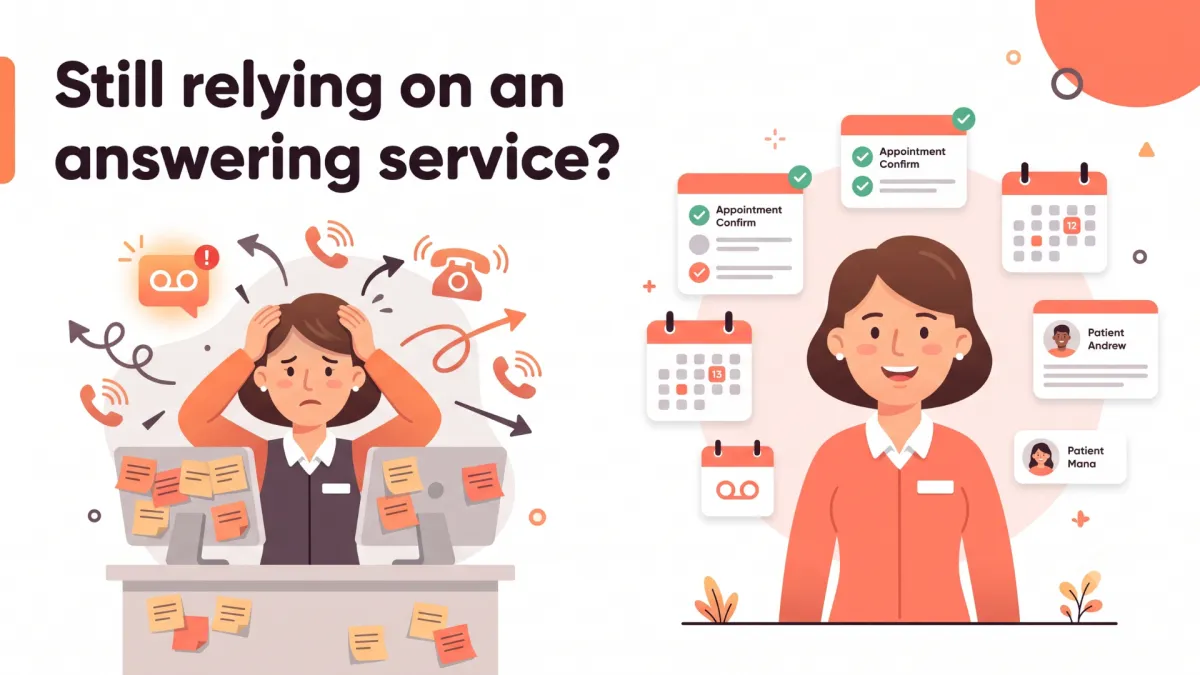
AI Receptionist vs. Answering Service: Best Choice for Medical Practices?
Traditional answering services take messages. AI receptionists solve problems. Compare the differences between the two, including appointment scheduling, patient experience, staffing efficiency, and cost, to determine which solution best supports your medical practice.
Healthcare has changed dramatically over the past decade.
Patients expect faster communication, easier scheduling, and better access to care. At the same time, medical practices are managing higher call volumes, staffing shortages, and increasing administrative demands.
For years, the solution to missed calls was simple: hire a traditional answering service.
Today, a new option has emerged.
AI receptionists are helping medical practices answer every call, schedule appointments, and support patients around the clock.
But how do they compare to traditional answering services?
More importantly, which option is the better investment for your practice?
Let's take a closer look.
Why Phone Calls Still Matter in Healthcare
Despite the growth of online scheduling and patient portals, the telephone remains one of the most important communication channels in healthcare.
Patients still call to:
Schedule appointments
Become new patients
Request prescription refills
Ask about insurance
Confirm office hours
Check referral status
Speak with a nurse
Ask billing questions
For many patients, especially older adults, the phone remains their preferred way to communicate.
That means every incoming call represents an opportunity to provide excellent service or lose a patient before they ever visit your office.
What Is a Traditional Answering Service?
Traditional answering services have supported medical practices for decades.
When your office is unavailable, calls are forwarded to a live operator.
The operator typically:
Answers the phone professionally
Collects the patient's information
Takes a message
Sends the message to your office
Escalates urgent calls according to your instructions
For emergency coverage and after-hours message taking, answering services have been a valuable solution.
However, they were designed during a time when patients expected callbacks.
Today's expectations are different.
The Limitations of Traditional Answering Services
Traditional answering services solve one problem.
They ensure someone answers the phone.
But they don't usually solve the patient's problem.
Imagine a patient calling to schedule an appointment.
With a traditional answering service, the conversation often sounds like this:
"I'll take your information and someone from the office will call you tomorrow."
The patient still doesn't have an appointment.
The office now has another callback to make.
The receptionist starts the next morning with another list of messages waiting to be returned.
While this process works, it creates delays for both patients and staff.
What Is an AI Receptionist?
An AI receptionist goes beyond answering the phone.
Instead of simply taking messages, it helps complete the patient's request during the conversation.
Depending on your practice's workflow, an AI receptionist can:
Schedule appointments
Reschedule existing visits
Answer frequently asked questions
Collect prescription refill requests
Route urgent calls appropriately
Capture patient information
Generate detailed call summaries
Transfer calls when necessary
Instead of waiting for someone to call back, patients receive immediate assistance.
Comparing the Patient Experience
Let's compare both experiences.
Traditional Answering Service
The patient calls after hours.
A live operator answers.
The operator takes a message.
The patient waits until the office opens.
Someone calls them back later.
The appointment is finally scheduled.
The process may take several hours or even a full business day.
AI Receptionist
The patient calls after hours.
The AI receptionist answers immediately.
The patient requests an appointment.
The AI finds an available time based on your scheduling rules.
The appointment is confirmed before the call ends.
The office receives an automatic summary.
One conversation.
No callbacks.
No waiting.
Why Immediate Resolution Matters
Patients don't enjoy waiting.
If scheduling an appointment becomes difficult, many will simply contact another provider.
This is especially true for:
Primary care
Urgent care
Pediatrics
Dermatology
Orthopedics
Physical therapy
Dental practices
Convenience influences where patients choose to receive care.
Practices that make scheduling easy often capture more new patients than those relying on voicemail and callbacks.
Supporting Your Front Desk Instead of Replacing It
One of the biggest misconceptions about AI is that it's designed to replace employees.
That's not how successful medical practices use it.
Instead, AI handles repetitive conversations while your team focuses on work requiring empathy and critical thinking.
Consider how many calls your staff answers every day involving:
"What are your office hours?"
"Do you accept my insurance?"
"I need to reschedule."
"I'd like to become a new patient."
These conversations are important but repetitive.
Automating them allows receptionists to spend more time helping patients who are physically in the office.
The Cost Difference
Hiring staff is expensive.
Traditional answering services typically charge based on:
Minutes used
Number of calls
After-hours coverage
Additional operator services
As your practice grows, those costs often increase.
An AI receptionist doesn't just answer more calls.
It reduces administrative work by resolving routine requests immediately.
Your staff spends less time making callbacks and more time caring for patients.
The result is greater efficiency without continually adding personnel.
Beyond Message Taking
This is where AI creates the biggest difference.
Traditional answering services focus on communication.
AI receptionists focus on completing tasks.
Instead of leaving your team with dozens of messages every morning, AI can:
Book appointments
Answer common questions
Collect refill requests
Route calls correctly
Document conversations
Generate summaries
Your office starts the day informed instead of overwhelmed.
Which Practices Benefit Most?
Nearly every specialty receives repetitive phone calls.
AI receptionists are especially valuable for:
Family Medicine
Internal Medicine
Pediatrics
Cardiology
Gastroenterology
Rheumatology
Dermatology
Orthopedics
Ophthalmology
Urgent Care
Practices with multiple providers or high daily call volume often see the greatest improvements.
Why Medical Practices Are Choosing AI
Healthcare is becoming more demanding.
Patients expect faster communication.
Staff shortages continue.
Administrative work keeps growing.
Rather than hiring additional receptionists every time call volume increases, many practices are choosing technology that scales with them.
AI provides consistent service whether your office receives ten calls or two hundred.
It never takes a lunch break.
It never calls in sick.
It never sends patients to voicemail because everyone is busy.
How Zaya Helps
Zaya was designed specifically for independent medical practices.
Unlike generic answering services, Zaya understands healthcare workflows and supports your existing staff.
With Zaya, practices can:
Answer every incoming call 24/7
Schedule appointments directly into supported EMRs
Collect prescription refill requests
Handle referral inquiries
Answer frequently asked questions
Provide multilingual patient support
Generate detailed AI call summaries
Follow customized workflows unique to your practice
Rather than replacing your front desk, Zaya allows your team to focus on delivering exceptional patient care while ensuring every caller receives prompt, professional assistance.
Frequently Asked Questions
Is an AI receptionist better than a live answering service?
For routine patient requests such as appointment scheduling and office questions, AI can often provide faster and more complete assistance. Traditional answering services remain useful for message taking, but AI resolves many requests during the first conversation.
Can AI schedule appointments?
Yes. Zaya can schedule appointments based on your practice's scheduling rules and supported EMR integrations.
Does AI replace receptionists?
No. AI is designed to reduce repetitive administrative work so your staff can focus on patients and more complex tasks.
Can patients still speak to someone?
Yes. Calls can be transferred according to your practice's workflow whenever human assistance is needed.
Is Zaya available after hours?
Absolutely. Zaya answers calls 24 hours a day, including evenings, weekends, and holidays.
The Future of Patient Communication
Traditional answering services have served healthcare well for decades.
But patient expectations have evolved.
People no longer want to leave messages and wait for callbacks.
They want immediate answers.
Practices that provide faster access create better patient experiences, improve scheduling efficiency, and reduce administrative burden for their teams.
AI receptionists represent the next evolution of patient communication.
They're not replacing the human touch that healthcare depends on.
They're ensuring every patient receives one from the moment they pick up the phone.
With Zaya, your practice never has to choose between helping the patient at the front desk and answering the next phone call. Both happen seamlessly, creating a better experience for everyone.
Talk to Zaya
Experience the difference. Tap the microphone to start a natural conversation with our AI right now.
You'll need to allow microphone access to start the demo.