
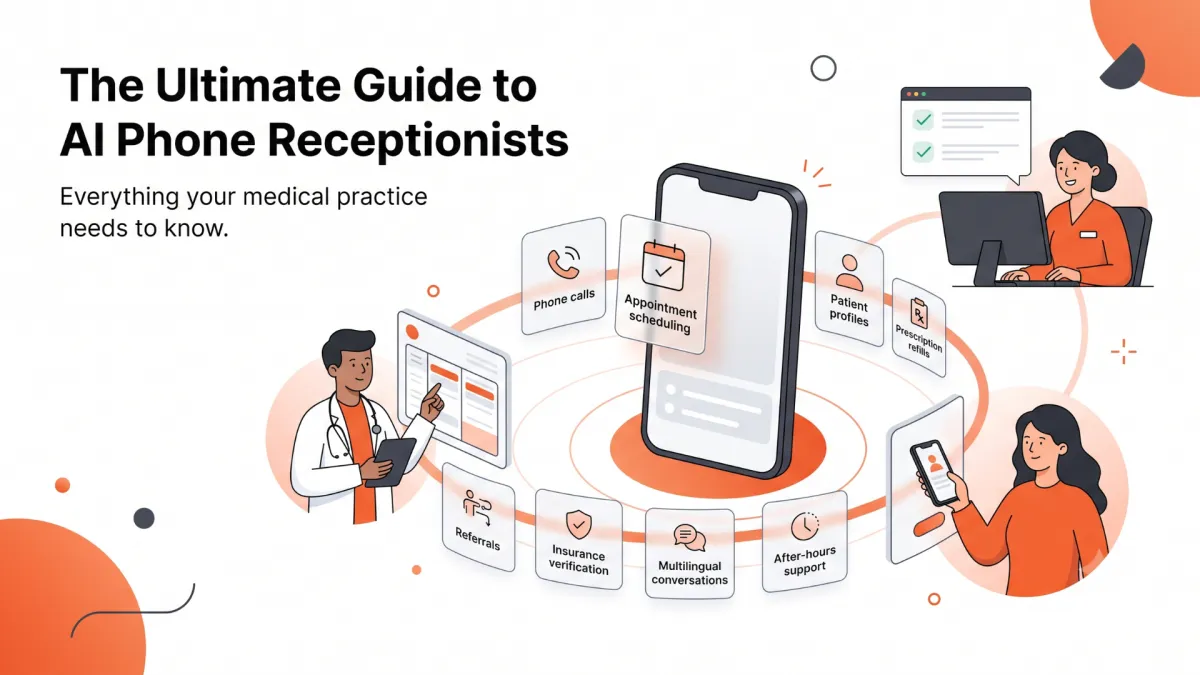
The Ultimate Guide to AI Phone Receptionists for Medical Practices
AI phone receptionists answer patient calls 24/7, schedule appointments, handle routine questions, collect prescription refill requests, and integrate with supported EMRs. They reduce missed calls, improve patient satisfaction, and free your front desk to focus on higher-value work without replacing your existing staff.
Artificial intelligence is transforming healthcare.
From clinical documentation and medical imaging to revenue cycle management and patient communication, AI is helping practices become more efficient while improving the patient experience.
One of the fastest-growing applications is the AI phone receptionist.
If you've heard about AI receptionists but aren't sure exactly what they do, you're not alone.
Many physicians and practice managers ask the same questions.
Can AI really answer patient calls?
Will patients know they're speaking with AI?
Can it book appointments?
Is it HIPAA compliant?
Will it replace my front desk staff?
The answer is simpler than you might think.
A modern AI phone receptionist isn't designed to replace people. It's designed to ensure every patient receives immediate assistance while allowing your staff to focus on providing exceptional care.
This guide covers everything you need to know before implementing an AI receptionist in your medical practice.
What Is an AI Phone Receptionist?
An AI phone receptionist is a conversational virtual assistant that answers incoming patient calls using artificial intelligence.
Unlike traditional phone trees that require callers to "Press 1 for appointments," an AI receptionist understands natural speech.
Patients simply talk the way they normally would.
For example:
"I'd like to become a new patient."
"I need to reschedule my appointment."
"I have a question about my insurance."
"I need a refill on my medication."
The AI understands the request, asks follow-up questions when necessary, and follows your practice's workflow to help the patient.
To the caller, it feels much more like speaking with a trained receptionist than navigating an automated phone system.
Why Medical Practices Need AI Receptionists
Today's front desk staff manage far more than answering phones.
On any given day they may be:
Greeting patients
Checking patients in
Verifying insurance
Collecting payments
Scheduling appointments
Processing referrals
Handling prescription refill requests
Responding to portal messages
Coordinating with providers
Phone calls interrupt every one of these tasks.
When multiple calls arrive at once, something has to wait.
Often, it's the patient calling your office.
An AI receptionist ensures every caller receives immediate attention while your staff remains focused on the patients already in the clinic.
What Can an AI Receptionist Actually Do?
Many physicians assume AI simply answers the phone and takes messages.
Modern AI receptionists can do much more.
Depending on your practice's workflow, they can:
Schedule Appointments
Patients can book appointments directly during the call.
The AI follows your scheduling rules, provider availability, appointment types, and clinic policies.
Instead of leaving a voicemail, the patient finishes the call with a confirmed appointment.
Reschedule and Cancel Visits
Patients frequently call to change existing appointments.
An AI receptionist can update schedules automatically, freeing staff from routine scheduling tasks.
Answer Frequently Asked Questions
Many incoming calls involve questions like:
What are your office hours?
Which insurance plans do you accept?
Where is your office located?
Which providers are accepting new patients?
What should I bring to my appointment?
Rather than interrupting your receptionist dozens of times each day, AI provides consistent answers immediately.
Collect Prescription Refill Requests
Patients can request medication refills any time of day.
The AI gathers all necessary information and forwards organized requests to the appropriate clinical team.
Handle Referral Requests
Patients often call asking about referrals.
The AI can collect referral information, explain the next steps, and route requests according to your workflow.
Route Urgent Calls
Not every patient should remain with the AI.
When appropriate, calls can be transferred to:
Nurses
On-call providers
Billing
Medical records
Practice managers
Urgent situations follow predefined escalation rules established by your practice.
Generate AI Call Summaries
Every conversation is automatically documented.
Your staff receives organized summaries instead of lengthy voicemail recordings.
These summaries typically include:
Patient information
Reason for calling
Actions completed
Follow-up items
That means less time listening to voicemail and more time helping patients.
AI Receptionist vs. Traditional Answering Service
Many practices currently use answering services.
These companies perform an important role, especially after hours.
However, there is a significant difference between taking a message and solving the patient's problem.
Traditional Answering Service:
Answers the phone
Takes a message
Sends the message to your office
Patient waits for a callback
AI Receptionist:
Answers immediately
Understands the patient's request
Schedules appointments
Answers questions
Collects refill requests
Completes many tasks during the first conversation
Patients no longer have to wait until the next business day for routine requests.
AI Receptionist vs. Voicemail
Voicemail has been the default backup for decades.
Unfortunately, patients increasingly dislike leaving messages.
A voicemail often creates uncertainty.
Patients wonder:
Did someone receive my message?
How long will I wait?
Should I call again?
Should I contact another practice instead?
AI eliminates that uncertainty by responding immediately.
Patients leave the conversation with answers instead of questions.
Does AI Replace Receptionists?
No.
This is one of the biggest misconceptions about AI.
Healthcare depends on human relationships.
Receptionists remain essential for:
Helping patients in person
Handling emotional situations
Managing complex insurance issues
Coordinating with physicians
Solving unexpected problems
AI simply removes repetitive administrative conversations that consume valuable time.
Think of it as giving every receptionist a highly efficient assistant.
What Happens After Hours?
Patients don't stop calling when your office closes.
Many people contact healthcare providers:
After work
During evenings
On weekends
During holidays
Early mornings
Without after-hours coverage, these callers often reach voicemail.
An AI receptionist remains available 24 hours a day.
Patients can:
Book appointments
Ask questions
Request refills
Leave detailed information
Receive immediate assistance
Your practice stays available even when the office is closed.
Can AI Integrate With My EMR?
One of the biggest advances in healthcare AI is direct integration with supported electronic medical record systems.
Instead of collecting appointment requests manually, AI can schedule patients directly into your calendar.
Benefits include:
Real-time scheduling
Updated provider calendars
Reduced administrative work
Fewer scheduling errors
Better patient experience
Practices no longer need to manually transfer appointment requests from voicemail into their scheduling system.
Is AI HIPAA Compliant?
Healthcare organizations have unique privacy and security requirements.
When selecting an AI receptionist, practices should ensure the platform supports:
HIPAA compliance
Secure data encryption
Role-based access controls
Audit logs
Secure integrations
Business Associate Agreements (BAAs)
Choosing a healthcare-focused AI platform is essential.
Which Practices Benefit Most?
Almost every specialty receives routine phone calls that can be automated.
AI receptionists are particularly valuable for:
Family Medicine
Internal Medicine
Pediatrics
Gastroenterology
Rheumatology
Dermatology
Orthopedics
Cardiology
Ophthalmology
Neurology
Urology
Pain Management
Behavioral Health
Urgent Care
Practices with multiple providers or high call volumes often see the greatest impact.
Common Myths About AI Receptionists
"Patients don't want to talk to AI."
Patients want fast, accurate service.
If their appointment gets booked quickly and their questions are answered correctly, most care more about the outcome than the technology behind it.
"AI can't understand complex conversations."
Modern conversational AI understands natural speech remarkably well.
It also knows when to transfer a conversation to a human.
"Implementation is difficult."
Most practices are surprised by how quickly AI receptionists can be configured around existing workflows.
The AI simply follows the same scheduling rules and policies your receptionists already use.
"AI will replace my staff."
The opposite is usually true.
Practices use AI to support their existing team, reduce burnout, and improve patient access.
How Zaya Helps Medical Practices
Zaya was built specifically for independent medical practices.
Instead of functioning like a generic answering service, Zaya becomes an extension of your front desk.
With Zaya, your practice can:
Answer every incoming call 24/7
Schedule appointments directly into supported EMRs
Handle appointment changes
Answer common patient questions
Collect prescription refill requests
Route urgent calls appropriately
Generate AI-powered call summaries
Support multilingual conversations
Follow your practice's unique workflows
Rather than replacing your employees, Zaya allows your team to spend more time delivering exceptional patient care while ensuring every caller receives immediate attention.
Frequently Asked Questions
Will patients know they're speaking with AI?
Modern conversational AI sounds natural and responds in real time. Most patients simply appreciate receiving immediate assistance.
Can AI schedule appointments directly into my EMR?
Yes. Zaya supports direct scheduling with compatible electronic medical record systems.
Can AI transfer calls?
Absolutely. Calls can be transferred based on your practice's customized workflow and escalation rules.
Is AI available after hours?
Yes. Zaya answers patient calls 24 hours a day, including evenings, weekends, and holidays.
Can AI support multiple languages?
Yes. Zaya can communicate naturally in multiple languages, helping practices better serve diverse patient populations.
The Future of Medical Reception Is Already Here
Patients expect convenience.
They expect immediate answers.
They expect healthcare practices to be as accessible as every other service they use.
AI phone receptionists make that possible.
By answering every call, reducing administrative burden, supporting your front desk, and improving patient access, AI helps practices deliver better service without adding additional staff.
The goal isn't to replace your receptionists.
It's to ensure every patient receives the attention they deserve from the moment they call.
With Zaya, your front desk gains a powerful teammate that's available 24 hours a day, seven days a week, helping your practice provide exceptional patient communication today and into the future.
Talk to Zaya
Experience the difference. Tap the microphone to start a natural conversation with our AI right now.
You'll need to allow microphone access to start the demo.