
AI Answering Service to Refill & Schedule Appointments
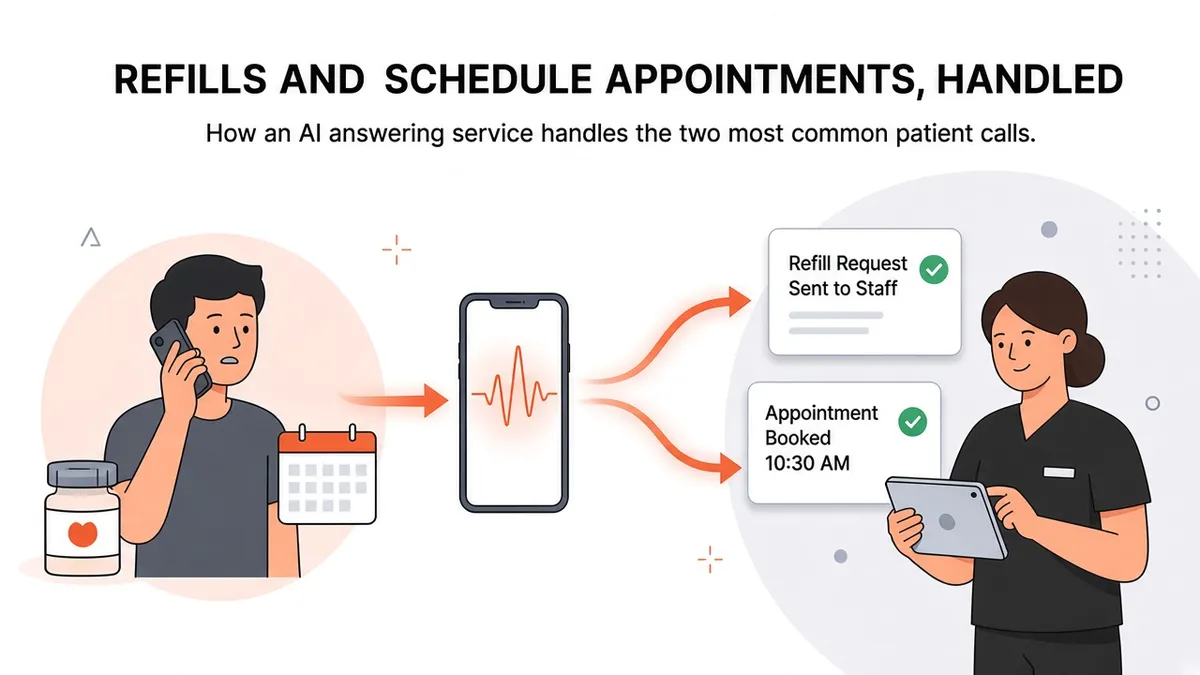
At most practices, two kinds of calls take up much of the phone day: patients who want an appointment and patients who need a prescription refill. They follow fairly predictable patterns, so they're a natural place for an AI answering service to help.
Some practice managers worry about refills in particular, because those requests involve medication and clinical judgment. This post walks through how an AI answering service built for medical practices handles each type of call, where the AI's job ends, and where your team takes over.
Why these two call types matter
Scheduling and refill calls are often routine, but they still need care:
Scheduling calls need the right provider, visit type, and time slot, and the appointment has to end up in the EMR.
Refill calls need the right patient, medication, and pharmacy captured accurately, and then a clinician has to decide.
If either type gets bounced around, patients call back, and every repeat call adds to your phone volume. An AI answering service is only useful if it handles both cleanly.
How an AI answering service handles a scheduling call
Here's how a typical scheduling call goes with Zaya Health:
The patient calls and says what they need. For example: "I need to schedule a follow-up with Dr. Lee."
Zaya verifies the patient by name and date of birth before it acts on their record.
Zaya checks the schedule in your EMR for availability that fits the request.
The patient picks a time from the real openings.
Zaya books the appointment directly in the EMR. No message sits waiting for staff to enter it later.
Zaya adds a telephone encounter to the patient's chart so there's a record of the call.
Your front desk sees the new appointment in the schedule just as if a staff member had booked it. For more on how this works with specific systems, see our pages for eClinicalWorks, athenahealth, Tebra, and the other EMRs on our integrations hub.
What about scheduling appointments after hours?
Many patients call when the office is closed, because that's when they have time. A traditional answering service can only take a message, so the patient waits for a callback the next business day. With an AI answering service connected to your EMR, the patient can book during that same after-hours call.
How an AI answering service handles a refill request
Refills work differently, and they should. An AI answering service should not approve refills. That decision belongs to your clinical team. The AI's job is to take an accurate request and get it to the right place fast.
With Zaya, a refill call typically goes like this:
The patient says they need a refill.
Zaya verifies the patient by name and date of birth.
Zaya collects the details your team needs. That usually means the medication name, the pharmacy, and anything else your practice asks for on refill requests.
Zaya records the request as a telephone encounter in the patient's chart, or sends it as a message into the EMR, to email, or to another protected system, depending on how your practice sets it up.
Your clinical team reviews and decides, the same way they would with any refill request.
Your team gets a structured request inside the system they already use, attached to the right patient. They don't have to decode a scribbled message or call the patient back just to ask which pharmacy.
Setting it up for your practice
Every practice handles these calls a little differently. During setup, which typically takes about two weeks with Zaya, we work with you on:
Scheduling rules. Which providers take which visit types, how long each runs, and which slots are held back.
Refill intake. Which details to collect and where refill requests should go.
Message routing. Who gets billing questions, records requests, and anything else that needs a person.
These choices keep your existing workflows intact. The AI follows your process. You don't have to change your process to fit the AI.
What about calls that aren't routine?
Some calls don't fit either category: a confused patient, a complicated insurance question, a symptom that worries someone. An AI answering service shouldn't try to handle these on its own. With Zaya, requests that need a person go to your team as messages, through the channel you've chosen.
Clinical questions and emergencies need a clear process no matter who answers the phone. Your greeting should direct emergencies to 911, and your on-call protocol should stay in place. When you evaluate any vendor, ask them to walk you through exactly what happens on an urgent call.
Common questions from practice managers
"Will patients be comfortable talking to an AI about medications?" Most refill calls are short and predictable: the patient names the medication and the pharmacy. The important thing is that the request is recorded accurately and gets to the right place. Patients usually care more about knowing their request was received than about who took it.
"What if the patient asks for a specific provider who isn't available?" Zaya checks the schedule in your EMR, so it can only offer openings that actually exist. If the patient's preferred provider has nothing that works, the patient can pick another time or provider your rules allow, or the request can go to your staff as a message.
"How do we know what happened on each call?" Each call is documented as a telephone encounter or a message, so your team has a record they can review in the EMR or the system you've chosen.
"Does this change how we handle refill approvals?" No. Approvals work the same way they do now. What changes is how the request arrives: it's complete, in a consistent format, and attached to the right patient.
Privacy and patient trust
Refill and scheduling calls involve protected health information. Any vendor answering these calls for you should sign a Business Associate Agreement. Zaya signs a BAA with every client and has HIPAA safeguards in place. Verifying patients by name and date of birth before acting on a record is part of handling these calls responsibly.
How this fits with the rest of your phone coverage
If you're still comparing options, our post on AI Receptionist vs. Traditional Answering Service covers the broader differences. And if you want to know whether your EMR is supported, the integrations hub lists every system we connect with, including Epic, NextGen, AdvancedMD, Elation, ModMed, and DrChrono.
Getting started
If you're thinking about an AI answering service for these calls, start with a short list. Write down the call types your office gets most often, how each one is handled today, and where the requests end up. Bring that list to any vendor demo and ask them to walk through each call type step by step. You'll learn quickly whether a product fits how your practice works.
Try it yourself
The best way to judge how an AI answering service handles these calls is to make one. Call our demo line at (713) 597-5176, pretend you're a patient, and ask to book a follow-up or request a refill.