
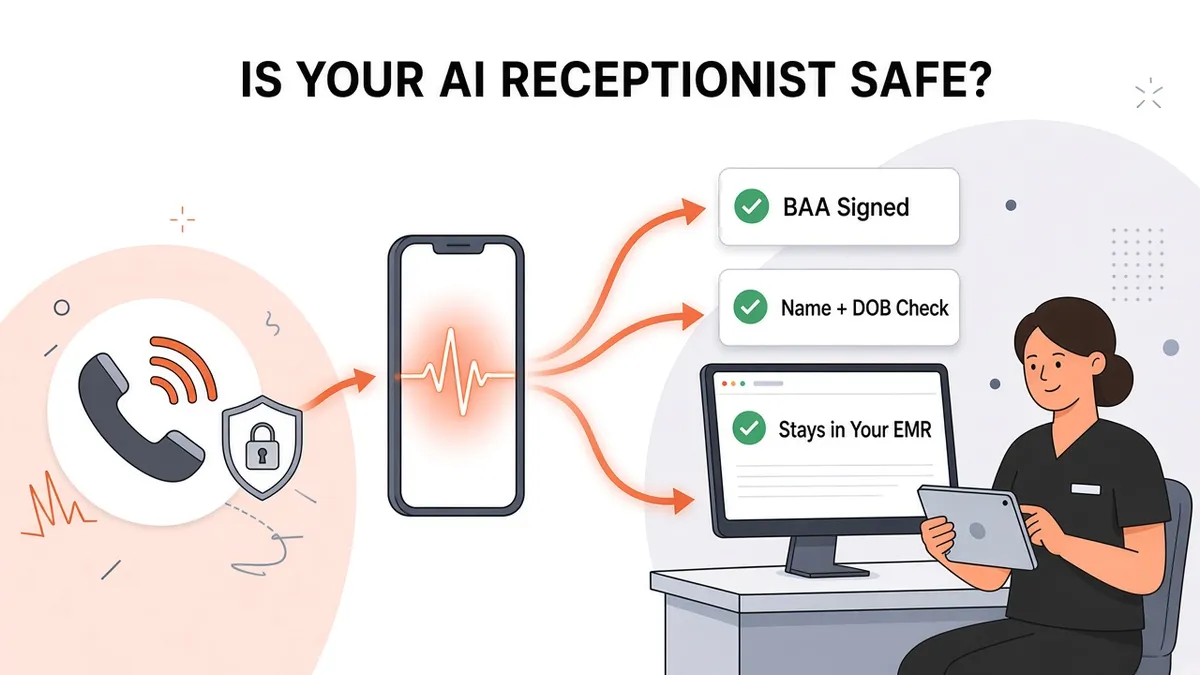
Is an AI Receptionist HIPAA Compliant and Safe?
For most practices, the first question about an AI receptionist isn't "does it sound natural?" It's "is it safe?" That's the right question. A receptionist handles patient names, dates of birth, appointments, medications, and messages for the care team. Any tool that touches that information has to be held to the same standard as the rest of your practice.
This post walks through what HIPAA means for an AI receptionist, what safeguards to ask a vendor about, where an AI receptionist should and shouldn't be involved in patient care, and how Zaya Health approaches each of these.
Does HIPAA apply to an AI receptionist?
Yes. If a vendor creates, receives, maintains, or transmits protected health information (PHI) on behalf of your practice, it is generally considered a business associate under HIPAA. An AI receptionist that answers patient calls, verifies identity, books appointments, and records requests clearly handles PHI.
That has two practical consequences:
You need a Business Associate Agreement (BAA) with the vendor before it handles patient information.
The vendor needs appropriate safeguards for the PHI it handles.
No software is "HIPAA compliant" on its own. Compliance depends on how a tool is used, the agreements in place, and the safeguards around it. When a vendor says "HIPAA compliant," the useful follow-up is: what does that mean in practice, and will you sign a BAA?
The BAA: the first thing to ask for
A BAA is a contract that spells out how a business associate may use and protect PHI, and what it must do if something goes wrong. Without one, your practice shouldn't share patient information with the vendor.
When you evaluate any AI receptionist, ask:
Will you sign a BAA with my practice?
Is the BAA available on every plan, or only some?
Can I review it before we start?
Zaya Health signs a BAA with every client and has HIPAA safeguards in place.
Patient verification: confirming who's calling
A receptionist shouldn't discuss or change a patient's record until it knows who it's talking to. This is one of the most important safety questions for any AI receptionist.
Zaya Health verifies existing patients by name and date of birth before it acts on their record, such as checking the schedule for them, booking an appointment, or recording a request. Ask any vendor exactly how it verifies callers and what happens when the details don't match.
Where patient information ends up
A common risk with phone coverage is information scattered across too many places: voicemails, sticky notes, personal email, text messages, or a separate vendor portal. Each extra location is one more place PHI has to be protected and one more place a request can get lost.
An AI receptionist connected to your EMR can keep that information where it belongs. Zaya Health:
Books appointments directly in your EMR.
Adds telephone encounters to the patient's chart to document calls.
Sends messages into the EMR, to email, or to another protected system, depending on how your practice sets it up.
When you set up any service, decide where each type of message should go, and make sure the destination is one your practice already protects. Read more about why the EMR connection matters in EMR-integrated answering service: what it is and why it matters.
Clinical safety: what an AI receptionist should not do
Data protection is half of "safe." The other half is making sure the AI stays in its lane.
An AI receptionist handles front desk tasks. It is not a clinician. In practice, that means:
It doesn't make clinical decisions. Refill requests are collected and documented for your clinical team to review and decide on. See how an AI answering service handles refill requests.
It doesn't diagnose or give medical advice. Clinical questions are recorded as messages for your care team.
It isn't an emergency service. Anyone having a medical emergency should call 911. For urgent concerns, your practice should keep following its own on-call protocol, and your phone greeting should say so clearly.
When you talk to vendors, ask how their system handles a caller who describes an emergency, and make sure the answer matches your practice's protocol.
A HIPAA and safety checklist for AI receptionist vendors
Use this list when you compare options:
BAA: Will you sign one with my practice, on every plan?
Safeguards: What HIPAA safeguards do you have in place for PHI?
Verification: How do you confirm a caller's identity before acting on their record?
Data destinations: Where do messages and call records go? Can they go into my EMR or another protected system?
Documentation: Are calls documented in the patient's chart?
Scope: What will the AI do on its own, and what always goes to my staff?
Emergencies: What does the AI tell a caller who describes an emergency?
Setup: Who configures the rules, and how long does it take?
For a broader evaluation list, see our AI receptionist buying guide for medical practices.
How this compares to a traditional answering service
Traditional answering services also handle PHI and should also sign a BAA. The safety questions are largely the same. One practical difference is where the information ends up: many traditional services deliver messages by phone, fax, or their own portal, which your staff then re-enter into the EMR. An EMR-connected AI receptionist can document calls directly in the chart. For a full comparison, read AI receptionist vs. traditional answering service.
Common misconceptions about AI receptionists and HIPAA
"If it's AI, HIPAA doesn't apply." HIPAA applies based on what information is handled and for whom, not on whether a person or software handles it. An AI receptionist handling PHI for your practice needs a BAA like any other business associate.
"A HIPAA badge on the website is enough." A badge isn't a contract. Ask for the BAA itself and ask what safeguards it covers.
"An AI receptionist will make decisions about patient care." A well-designed AI receptionist handles front desk tasks like scheduling, documentation, and messages. Clinical decisions stay with your clinicians.
"Patient information has to leave the EMR." With an EMR-connected receptionist, appointments, telephone encounters, and messages can be recorded right in your EMR.
Your practice's part
Even with the right vendor, some safety decisions belong to your practice:
Set clear rules about which visit types the AI can book and where messages go.
Keep your emergency and on-call messaging current.
Limit who can access message destinations like shared inboxes.
Review telephone encounters and messages during the first weeks to confirm everything is routed correctly.
Include the vendor in your HIPAA documentation, along with the signed BAA.
With Zaya Health, setup takes about two weeks, which gives you time to work through these decisions before going live.
EMR integrations
Zaya works inside the systems your practice already protects:
- Custom HTML/CSS/JavaScript
See the full list on our integrations page, or read our guide to AI medical answering services.
Hear it for yourself
Listening to a call is a good way to see how verification and request handling work. Call our demo line at (713) 597-5176, try booking an appointment as a patient would, and notice how Zaya confirms who you are before it acts
Prefer a walkthrough? Book a Demo.